
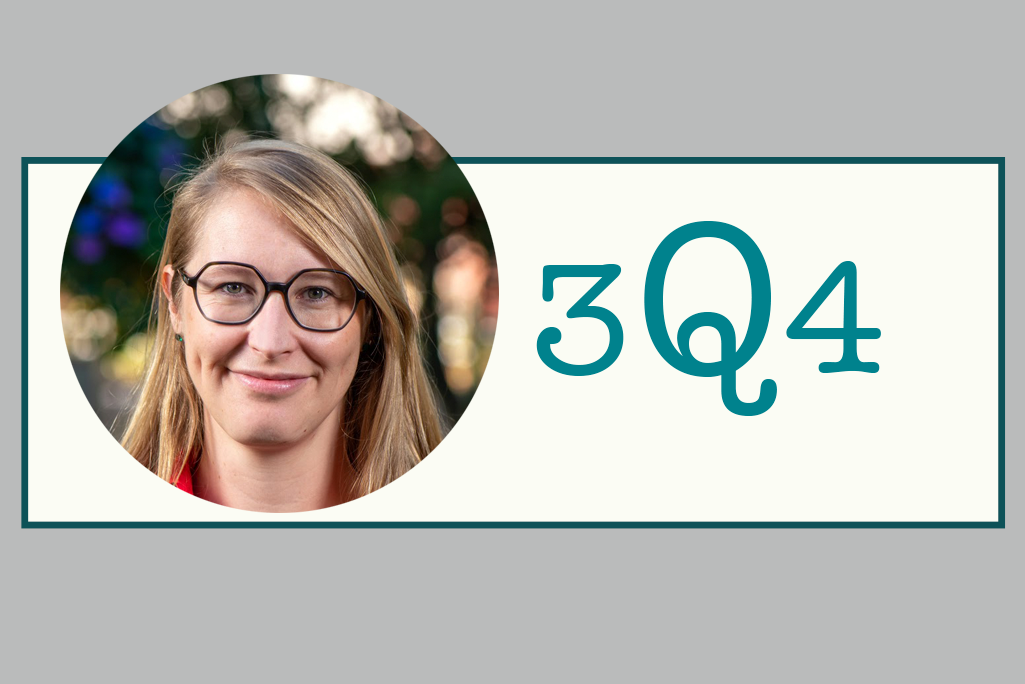
Lydia Rachbauer joined Berkeley Lab in 2019 as a Postdoctoral Researcher in the Biological Systems and Engineering Division in the Biosciences Area before transitioning into her current role as Research Scientist. Her work harnesses the power of microbial communities to enable biomanufacturing from a wide variety of waste streams—including marine seaweed, industrial residues, and syngas—into renewable fuels, chemicals, and products. A first-generation college graduate who grew up in the Austrian countryside, Lydia credits the people around her for setting her on this path: “I owe it to my parents and supportive childhood teachers that my early interest in science turned into a career.”
Lydia also serves as Vice-Chair of the Women’s Support and Empowerment Council (WSEC). Read about how bold thinking, meaningful mentorship, and a commitment to the Lab’s Stewardship values shape her work and her vision for the future of science.
Could you share your role in WSEC, your experience in this position, and how you support WSEC’s mission?
As the longest-standing ERG at Berkeley Lab, the Women’s Support and Empowerment Council (WSEC) is a vital hub for networking, advocacy, and professional growth. In my role as Vice-Chair, I collaborate with our Chair and Executive Committee to strategize and bring impactful initiatives to life. We plan a lot of events—from professional headshots and self-defense workshops to panel discussions and book clubs—but it is our enthusiastic members who truly drive our success.
While these events represent our more public-facing work, much of our impact happens behind the scenes. Our policy subcommittee, for example, works closely with HR on long-term initiatives that align with WSEC’s mission of strengthening the Lab’s culture. A major focus of our advocacy is identifying opportunities to create a more family-friendly workplace and improve work-life balance—essential factors in celebrating the contributions of women and fostering professional growth.
My journey with WSEC, as a member, then subcommittee chair, and now Vice-Chair, has been incredibly rewarding. It allows me to look beyond our daily scientific output and take an active role in building a supportive environment. Being part of such an inspiring, driven, and welcoming group of people across job titles, and Divisions, is a constant reminder of why creating a space for women to thrive and lead is so essential to the Lab’s future.
Innovation often requires taking risks. How has the Lab’s culture encouraged you to pursue a ‘bold idea’ that felt outside the box?
For me, Berkeley Lab has always been a place where thinking outside the box was strongly encouraged. It also definitely helps to casually brainstorm with really bright minds over coffee so a lack of funky ideas is usually not a problem.
I remember my supervisor walking up to me towards the end of my postdoc project and just asking me to write up any blue sky ideas I was passionate about. ‘If you could do anything, what would you want to work on for the next couple of years?’ Just a simple one pager. This idea turned into LDRD (Lab-Directed Research and Development) funding and the kickstarter for a follow-up project I am currently leading as the Principal Investigator.
I’ve been hearing high risk/high reward a lot during my time at the Lab and came to realize that it is not just empty words. Turning bold ideas from loose thoughts into a tangible project is hard, and requires time to allow for creative problem solving. I like to think about my ideas through an application-based lens from a broader perspective: If it works, will it matter? And if it would, it is my job to figure out how we can make it work. I love collaborating with my chemist co-workers to see if a microbe can solve something chemistry is struggling with. Nature usually tends to have its ways. We just need to take a really close look and transfer it into an application.
How do you balance the drive for scientific discovery with our stewardship values? How does discovery balance with working safely and ethically?
I’d argue that scientific discovery and responsible stewardship are not mutually exclusive; in fact, they go hand-in-hand. When we explore bold ideas in unknown territory, we need a plan to do so safely and ethically. Just as you wouldn’t dive into the deep sea without an oxygen tank and safety gear, science needs robust experimental planning and safeguards. Curiosity and an open mind are essential for following unexpected observations. In fact, many big discoveries have originated from serendipitous findings, which then had to be proven to be sure the results are real. This process of exploration and verification must be guided by a culture of skepticism, where results that seem too good to be true are subject to rigorous scrutiny and repetition. Only when error bars are reasonable do we get to shout ‘Eureka!’ (Spoiler: we actually don’t.)
At Berkeley Lab, safety is a core component of our culture, designed to foster innovation while protecting the well-being of our workforce. We strive to create an environment where everyone can contribute to cutting-edge science without compromising their physical or psychological safety. The Lab provides a suite of resources to support us, including EHS, Safety Specialists, Ergo Advocates, and comprehensive training programs for managers and leaders, such as the Director’s Stewardship Summit program. By working together and upholding the highest safety standards, we can ensure that our pursuit of scientific discovery is always balanced with responsible stewardship.
As a researcher in the middle of your career journey, what is a ‘hidden gem’ of advice you’ve received from a mentor that still guides your work?
It goes without saying that every member of the Berkeley Lab team drives world-class science. Yet, despite knowing this deep down, many of us—particularly women and early-career researchers—still grapple with imposter syndrome. Research actually backs this up: the more a field is perceived to require ‘brilliance’ for success, the more likely underrepresented groups and those starting their careers are to feel like impostors.
I have navigated these feelings myself, and the most effective antidote I’ve found is meaningful mentorship. I’ve had a variety of mentors throughout my career—mostly male allies—who tremendously helped shape my path. However, one woman mentor stood out by reshaping my idea of what mentoring looks like. A big aspect of her role was simply being my cheerleader. It was incredibly empowering to have someone in my corner to quiet the doubt and remind me of my capabilities when I questioned myself. She didn’t need proof of my accomplishments; I never felt the need to justify the worthiness of my scientific profile. That reassurance was a game-changer, and I still channel her voice whenever that ‘imposter’ resurfaces.
Because of this, I believe it is a core part of my job to extend that same implicit trust to the next generation of scientists who might feel intimidated by the excellence Berkeley Lab radiates. I’ve found that the unwavering confidence from a supervisor, manageable work assignments that allow for exploration, and reassurance that it’s ok to make mistakes, is a great recipe to instill a sense of belonging. This is especially vital for those from underrepresented communities who may struggle with belonging more than others. For me, the greatest reward is receiving an email from a former intern or junior colleague sharing that they’ve been accepted into their dream program—knowing they are now thriving in their own unique STEM journey.
Learn more about Stewardship at Berkeley Lab
Learn more about the Women’s Support and Empowerment Council (LDAP required)
