
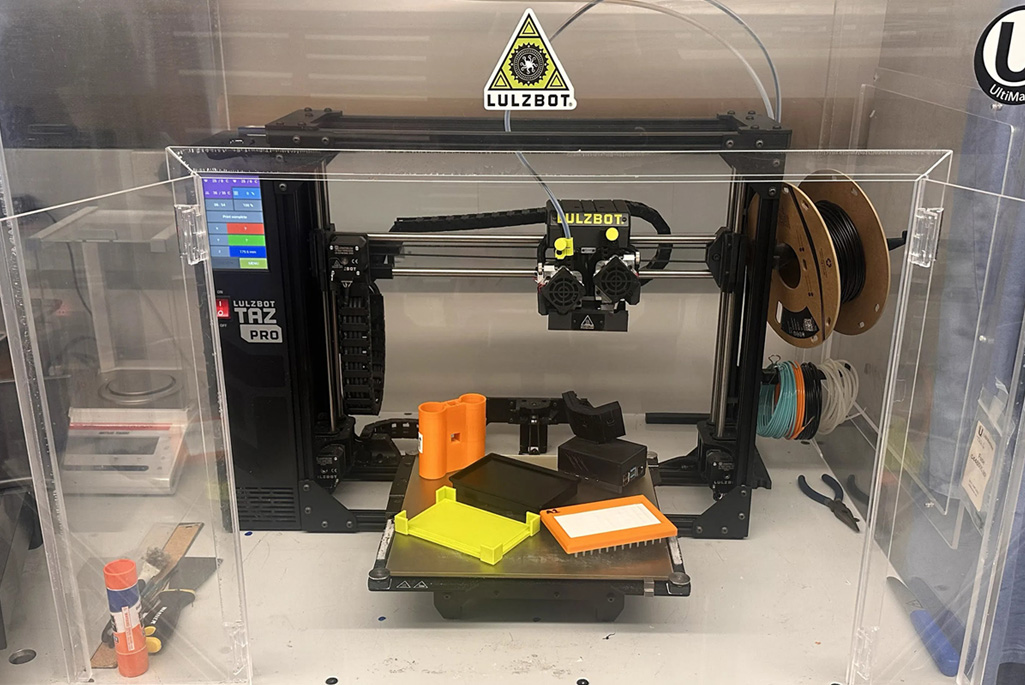
LT Cornmesser, David Dilworth, and Joseph Zorzi have nearly 50 years of combined experience in lab automation. As the Lab Automation Team within the Joint Genome Institute, they design and build the systems that keep JGI’s research moving, and 3D printers have become one of their most-used tools.
When EHS began developing the 3D Printing Equipment website, the team hosted several on-site walkthroughs and demos to help inform the guidance. The site brings the Lab’s safe-use practices together in one place, making it easier to find what applies to 3D printing work and strengthening the Lab’s shared commitment to a proactive safety culture.
Elements sat down with LT, David, and Joseph to talk about their work and what the new guidance means for them.
Q. Tell us about your role and how you came to lab automation.
LT Cornmesser: I’m the Automation Lead for the Joint Genome Institute. My team writes the programs and makes sure they’re running correctly. The core idea is that you can’t keep putting more and more people in a lab — you need some way to increase throughput, and that comes through robotic automation. I’ve spent about 30 years in this area, across startups, national labs, university labs, diagnostic companies, and pharmaceuticals. Early in my career, I had the opportunity to build the instrumentation myself, and I realized pretty quickly that I was much happier playing with toys and instruments than working at the bench.
David Dilworth: I’m a Lab Automation Engineer on LT’s team. My background is in cell and molecular biology, and I worked at a lab bench for a couple of decades before segueing into lab automation, where I’ve been for six or seven years now. I moved over because I recognized automation as something deficient in my own skill set. I kept thinking, if only I had somebody who could do what we do now. I saw how useful it was from a bench scientist’s perspective, so I was very motivated to make the switch.
Joseph Zorzi: I’m also a Lab Automation Engineer within JGI, and I’ve been doing automation for over a decade. I started at Thermo Fisher in a lab transfer role, where we set up an entire process that moved from Austin, Texas, to Pleasanton. I started fixing a lot of the machines during that time, and then applied for a job in automation to get out of the lab.
Q. How does your team use 3D printers day-to-day?
Joseph: A lot of what we make is small adapters, such as parts that fit the SBS footprint labware we use across almost all of our instruments. Sometimes people need height adjustments. On one of the magnetic blocks we use, a thin printed insert lets us orient the beads in different locations within the well as we’re running magnetic separations. Minor adjustments like that have been really helpful.
The other category is small tools. Right now we’re working on a barcode mask, so that every time someone places a label on a plate, it ends up in the exact same location, as long as they’re using the mask.
On the bigger side, we have custom hardware deployed around the Lab that we designed ourselves, including cases, platforms, and electronics boxes. We built a little camera system about a year ago with a Raspberry Pi in the base and three cameras angled to give us a two-meter view of the entire inside of an instrument.
All of it helps make our researchers’ workflows a little easier and more repeatable.
David: The adapters, tube holders, things to raise something a fraction of a millimeter — those are the most common uses. I’d also add that it’s indispensable for prototyping. If you have an idea for something that would ultimately be better made in machined metal, you can still design and print it with a 3D printer and test it a dozen times over very cheaply first.
Q. How does that support JGI’s and the Lab’s mission?
David: Two things: we support increasing end-to-end automation and throughput, which reduces the need for operator intervention.
Joseph: I’d add repeatability to that. When a user runs an experiment by hand, there can be more day-to-day variability in how the process gets done. But if the machine is calibrated correctly, running that same method over and over should give much more reproducible results. So along with higher throughput, we’re also making sure things stay consistent as they move through the process.
LT: We focus on how we can improve things at the Joint Genome Institute. As one example, an instrument was recently purchased, and the adapters that came with it don’t let the machine align correctly at the very beginning of a run. The team sent us a request for a new adapter. We could spend $1,500 and have a machinist do it, or we can spend 60 cents to put it on a machine and print it here.
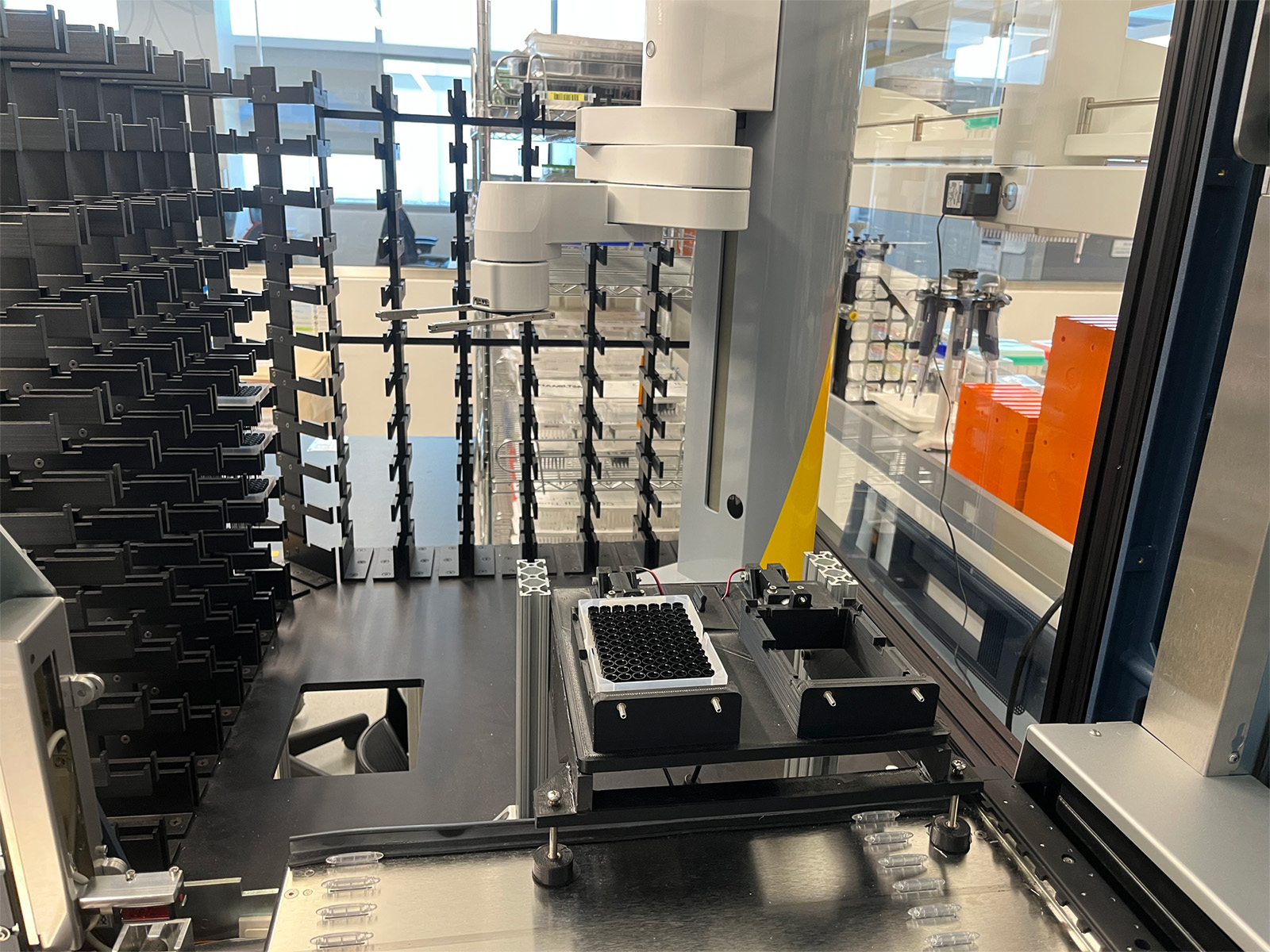 Our work also filters out into the larger Lab. There are researchers outside JGI we support, and I’ve been asked to help with different automation projects. Another example is a request that came to me about presenting more racks of tips to a robot. You only have room for about 10 racks on the deck, and some runs take over 100. I designed what we call the TDS, the Tip Delivery System. The first thing I did was 3D print my idea and send it to a couple of teams to try out. They came back and said it worked great, so we built it. It has a robotic arm that picks up tips, hands them to the robot, and throws the old racks away. Parts of it are still 3D printed.
Q. What does the new 3D printing guidance and website change for you?
David: The best part for me is having everything codified. If I have a question, I know where to look, and I know who to ask for follow-up. It also gives me some relief. Even before the website, what we were doing was generally correct, and now we can quickly fix anything where we deviate.
And it gives me the confidence to experiment more with different filament materials, which I’ve always been hesitant to do. Knowing a lot of it is pre-cleared and that there’s a list of what I can and can’t do makes me more comfortable going a little outside what we normally print with.
Joseph: If you look through the safety guidelines, filament deposition, which is what we all use, is much lower risk than the other systems used at the Lab. If we were to use a resin printer, there would be more restrictions on what we could do, and metal printing is different again. That’s actually useful to see laid out, because it tells you what changes if you move to a different process. For us, it confirmed we were already following the guidelines without knowing them, and it means we know what’s involved if we need to expand for another project.
Visit the 3D Printing Equipment website for guidance on safe handling, hazards, and controls.
For questions or concerns, please contact your Division Safety Coordinator (DSC) or the EHS Robotics subject matter expert.
