
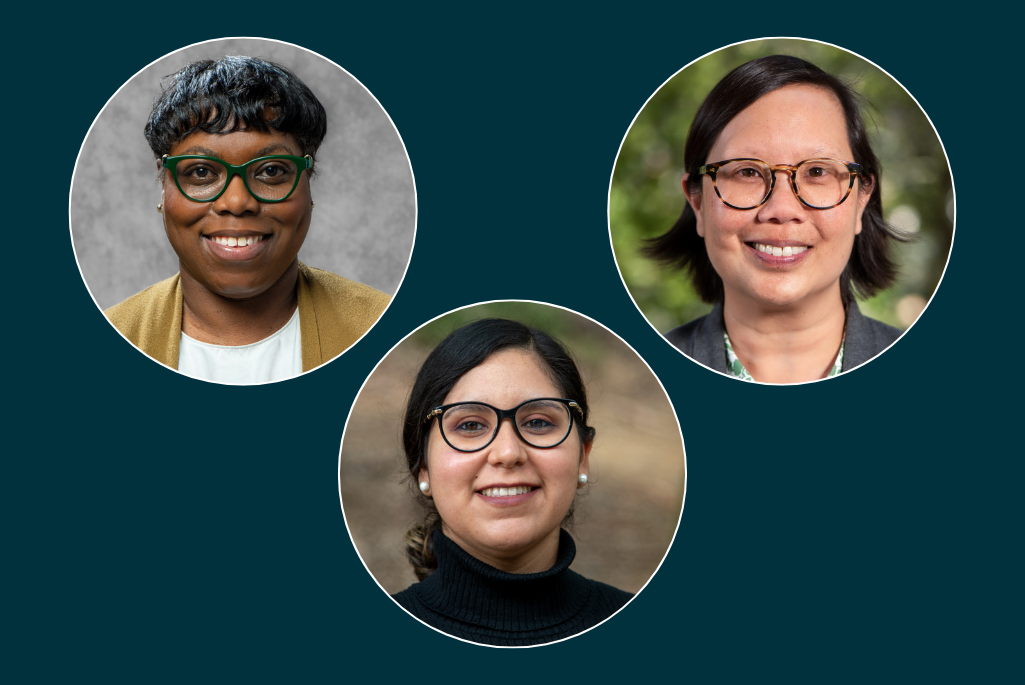
Bringing the Lab to our community is a core stewardship value, guiding how we build partnerships and invest in the next generation of talent. Two offices lead this work: the Academic Learning Internships and Faculty Training (A-LIFT) Office, which develops the Lab’s future STEM workforce, and the Government and Community Relations (GCR) Office, which builds partnerships with our neighbors, government officials, and community members.
Elements sat down with Faith Dukes (Director of STEM Education and Workforce Development Programs, A-LIFT), Jenn Tang (Director of Community Relations, GCR), and Joselyn Delgado (Senior Community Relations Administrator, GCR) to learn how their offices support the Lab’s mission, our surrounding communities, and the next generation of STEM professionals.
Can you each give us a brief overview of your office and how it supports the Lab’s mission?
Jenn: The Lab’s Government and Community Relations Office (GCR) is part of the Lab Directorate, and we work at the direction of Lab leadership to advance the Lab’s research, institutional, and good neighbor goals and objectives. We do this by engaging with community partners and leaders, neighbors, federal, state, and local government officials, as well as other key stakeholders, on the value and impact of the Lab’s research. We focus here locally, but we also like to tell stories about how the Lab impacts the state, the nation, and the world at large. Within the GCR office, the Community Relations team works to ensure that the Lab is a good neighbor and a responsible and engaged community institution. We think of ourselves as the bridge between the Lab and the communities that surround us.
One of the ways the Community Relations team supports the Lab’s mission is through the Community Advisory Group (CAG). It was founded in 2010 and serves as a forum for discussion around the Lab’s initiatives and activities. While it initially focused on capital projects and scientific endeavors that might impact the community, it has expanded to identify opportunities for collaboration to support a more vibrant community locally.
The Community Relations team facilitates visits to the Lab as well, ranging from local City of Berkeley delegations interested in partnership opportunities to monthly public tours offering a firsthand look at our work. By enabling people to learn more about our science, we build third-party advocates for the Lab’s mission. We also champion the Lab’s mission by participating in civic events, but I’ll let Joselyn talk about that a little bit later.
Faith: The Academic Learning, Internships, and Faculty Training Office (A-LIFT) is a continued offshoot of the Lab’s community relations efforts and workforce initiatives. We deliver experiential learning programs for K-12, undergraduate, post-baccalaureate, and graduate students, as well as faculty. Our goal is to inspire and equip people interested in STEM or STEM-adjacent careers and help them be a part of the next generation of scientists, engineers, and researchers both here at the Lab and as a part of the national lab complex.
As part of our community work, we focus locally on K-12 students and educators to increase awareness of the national lab system and Berkeley Lab. We provide opportunities for students to engage with us and host about 900 students for tours annually. We also go out to middle and high schools in Berkeley, Oakland, Richmond, and Emeryville, reaching another 800 students each year for the past three years. This is an investment in building our talent locally and supporting the surrounding regional economy in the Bay Area.
In addition, our DOE-funded national programming supports our post-secondary students and faculty in launching their careers in STEM research, technical positions, and more. Currently, we’re developing additional training programs in emerging technologies, such as quantum and AI, guided by the Lab’s research portfolio. We want to integrate more people into the fields specific to DOE research and Berkeley Lab and enable them to be a part of the ecosystem driving innovation and scientific discovery here.
Why does being connected to our broader community matter to who we are as a Lab, and what does that connection look like in practice?
Jenn: It matters tremendously for the Lab to be connected to the broader community. When you think about the Lab’s stewardship values, especially the pillars of trust, service, and respect, community engagement is essential in maintaining and advancing all three. The Community Relations team works hard to ensure that the public has a positive view of the Lab, from both a scientific and a good neighbor perspective.
For example, to address concerns about wildfire risk in the Berkeley Hills, our Community Relations team, in collaboration with many other Lab colleagues, has spent years engaging with local stakeholders, including the mayor and City Council, to communicate about the Lab’s proactive mitigation programs.
In addition to providing regular briefings on our wildfire work, we’ve also invited them to observe our full-scale exercises. This year, we had participation from the Berkeley Mayor’s Office, our Berkeley City Council member who represents the Lab, the Berkeley Fire Safe Council, and our Community Advisory Group. They heard from Lab leadership about our emergency wildfire response, and it was an incredibly valuable opportunity for us to build trust on a topic important to the local community.
Recently, we invited the same group back to observe the removal of dead, dying, or otherwise hazardous trees northwest of Building 90 as part of our proactive wildfire mitigation efforts. Those stakeholders got to see that work happening firsthand, allowing them to better understand how the Lab works in partnership with local community members, the City of Berkeley, and UC Berkeley to achieve common goals.
We are also grateful to Lab leadership for providing fee funding to the GCR office, which supports charitable contributions for nonprofits whose missions align with the Lab’s, particularly those focused on STEM education. This funding allows our community partners to maintain vital programs and services in the East Bay. Beyond financial support, the Lab is committed to volunteering at these programs, with staff donating many hours of their time. This hands-on involvement builds trust and demonstrates a tangible commitment to our partners, fostering stronger community relationships.
Joselyn: Meeting the public where they are, explaining our science in an accessible way, and sharing how our research impacts our everyday lives is important in making the Lab more approachable. Many people have never heard of Berkeley Lab or national labs, so we need to build trust and continue to be present at outreach events to show who we are and what we represent.
It goes hand-in-hand with our stewardship values. We are driven by our commitment to public service, and we strive to earn the trust of the public and the scientific community. We love having our scientists come out to our events to help us inspire the next generation of scientists and create opportunities for collaboration with our event attendees. For example, someone on our public tour connected with the A-LIFT team to arrange a visit to the Lab for her high school students. Just having those small, spur-of-the-moment connections is really valuable.
We also participate in various events throughout the year, including cultural events, street fairs, parades, food bank events, trail cleanups, waterfront cleanups, STEM days at sporting events, and the farmer’s market. We’re always open to new opportunities, so we listen to our volunteers to ensure we provide engaging activities, which are often well-attended. Our employees have made a significant impact by volunteering, and we want to continue building on that relationship.
Faith: Our office focuses on the future of the Lab, and that requires engaging the people and educational institutions around us, from K-12 to our community colleges to our four-year universities. We build relationships and meet people where they are to share what the Lab has to offer and how we can best partner effectively. This includes developing the next generation of Lab talent and addressing curriculum gaps to help students and educators engage with emerging fields led by national labs.
For example, we currently offer a quantum camp for community colleges. We aim to expand on that by continuously seeking community feedback on where they’re at, what would work best for them, and how we can work together to move us forward. To have a better opportunity to showcase what Berkeley Lab is and does, we need to be out in the community building relationships and helping people understand the mission and the work that’s being done here, which is amazing.
From an economic standpoint, we’ve provided learning stipends for more than 500 high school students participating in internships over the past five summers. We are one of the few work-based STEM programs for young people that doesn’t charge a fee to learn about science and technology, communication, and policy for a summer opportunity. As all of our programs are either free or paid opportunities, we are effectively removing an economic barrier to local residents.
We share with government officials how our programs support their constituents. These experiences also influence the next generation by exposing them to diverse fields like biology, materials science, or engineering that many didn’t even know existed.
Though outcomes can vary, bringing young people and allowing them to engage with our staff in technical or STEM support-adjacent roles makes a clear impact on our students. Those students are progressing from community colleges to four-year institutions, PhD programs, into technical careers, and often come back to the Lab as scientists. There are a few people currently engaging with our programs who are former SULI and CCI interns.
For instance, we had someone from a local quantum technology company on a panel talking to young people about how they can get into the quantum workforce. He was a SULI intern in 2015 and 2017 and now has a PhD. Seeing former participants in our local and national programs return and engage with us demonstrates a tangible return on investment. Through these initiatives, we actively embody the Lab’s commitment to stewardship and to supporting people and scientific research.
What’s your favorite part about working in your offices at the Lab?
Joselyn: I honestly love being out at our outreach events. I try to go to every single one because I genuinely enjoy going to them. I also really enjoy meeting the Lab employees who volunteer at our events and learning more about their work and their interests. It’s inspiring to see how passionate they are about their work and how excited they are to share that passion and knowledge with the community. Seeing that enthusiasm always motivates me to do more and reminds me why the work we do through community relations is so meaningful.
Jenn: One of my favorite parts of our job is bringing people together from across the Lab and seeing community being built. When Joselyn and I organize volunteer opportunities, we’ll see sign-ups from senior leadership, postdocs who have just joined the Lab, and everyone in between. We love facilitating opportunities for Lab employees to come together and get to know one another as people outside of their work. We have a lot of fun while providing a vital service to organizations in the community that we partner with. It’s a win-win-win for everybody involved, and that is incredibly gratifying.
Faith: I’ll echo that: bringing everybody together. The same scientists who are renowned in their fields will also come in to teach our data science program and help students learn to code. Everyone is eager to step up and lend a hand however they can, and I never feel unsupported in our mission when reaching out externally. If anything, I am completely confident speaking with the public because I know that whether we need a biologist, chemist, or physicist, I can readily connect with one. They are always enthusiastic about sharing their research and welcoming visitors. Furthermore, our leadership fully backs these efforts and actively participates as well.
A few weeks ago, our Lab Director Kathy Yellick and Nobel laureate Saul Perlmutter closed out a portion of our high school internship programs. We kept Saul’s role as the keynote speaker a secret from the high schoolers, who were participants in our QCamp program and had spent the entire summer in Building 59 passing by the Perlmutter supercomputer every day. The moment Saul’s name appeared on screen, you just heard this audible gasp as they connected the supercomputer they walked past with the person right in front of them. At the end of the day, our goal is to translate the extraordinary work happening here into personal, individual experiences. It’s life-changing for the people we engage with.
How can new employees get involved?
Joselyn: Employees can use the service portal, which is a one-stop shop for volunteer opportunities with the Lab’s A-LIFT team or the Community Relations Office. They can set up a profile in the service portal to sign up for volunteer activities. Employees can also email us if they have any questions. We’re happy to chat one-on-one if they have specific questions.
Jenn: In the service portal, we have something for everybody. On the community relations side, they can engage directly with the public, support local food banks, or get their hands dirty, like pulling weeds with one of our other community partners. The portal is a nice way to see all the different organizations we partner with in one place. Another benefit is that, come PMP/PEP time, Lab employees can talk about how they’re fulfilling their stewardship values and supporting the broader community through volunteering.
Faith: The service portal is the best way to find K-12 opportunities as well, including our one-day, three-day, or 1-week programming and workshops. We’re always in need of mentors, and issue calls year-round via Elements, with our biggest calls from late fall through early spring. We host around 250 interns and faculty in the summertime, and around 30 interns each fall and spring. Opportunities to get involved range from a few hours to one day, or longer-term, such as mentoring or developing a curriculum based on your research. We also welcome any other ideas you may have that would support professional growth at the Lab in STEM education or workforce development. Both of our offices also send out newsletters roughly once a month with information on volunteer opportunities at the Lab and in the Bay Area.
Stay up to date on volunteer opportunities at A-LIFT and GCR by subscribing to their newsletters below:
