
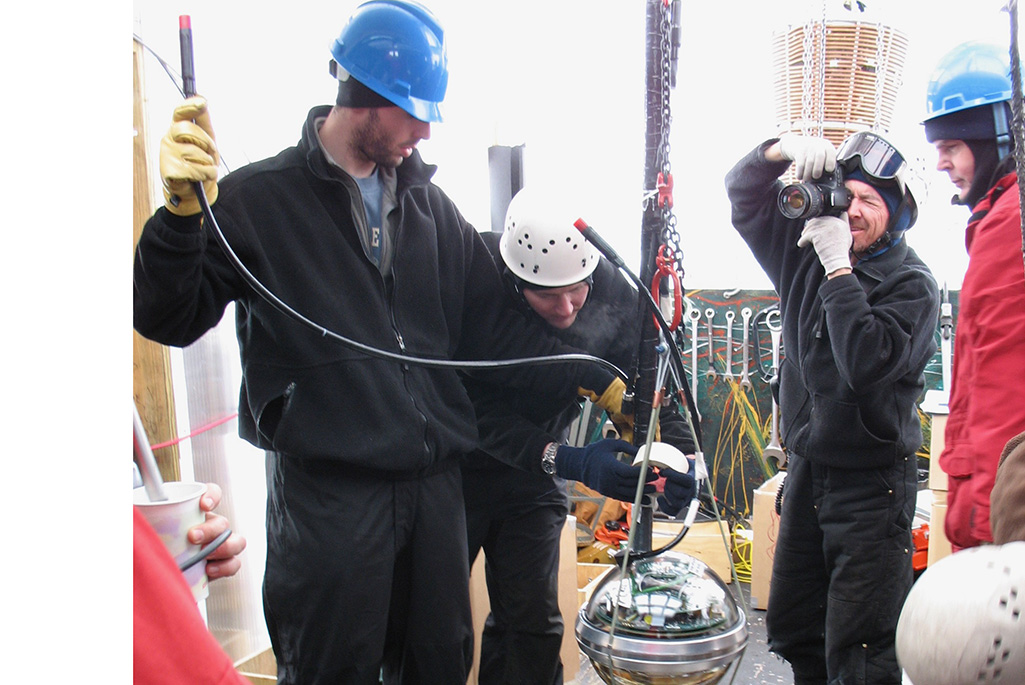
The Nobel Prize news release announcing the award adds: “Francis Halzen realized that ice at the South Pole could be used to track particles known as neutrinos. His vision and scientific leadership have been fundamental for the IceCube Neutrino Observatory – a cubic kilometer of ice that is equipped with light sensors. Using IceCube, researchers can capture neutrinos from extremely energy-rich processes in the distant universe.”
The IceCube Neutrino Observatory is designed to observe the cosmos from deep within the South Pole ice by searching for nearly massless subatomic particles called neutrinos. These high-energy astronomical messengers provide information to probe the most violent astrophysical sources: events like exploding stars, gamma-ray bursts, and cataclysmic phenomena involving black holes and neutron stars.
Approximately 450 physicists from 58 institutions in 14 countries make up the IceCube Collaboration. IceCube is operated by the University of Wisconsin–Madison and is supported by the National Science Foundation.
Berkeley Lab is among the collaborating institutions; its scientists and engineers played a significant role in IceCube’s conception and construction and continue to play an integral role in data analysis. This 2021 article celebrating IceCube’s first decade of discovery provides an overview of the Lab’s contributions, including from NERSC and the Nuclear Science, Engineering, and Physics Divisions.
“The IceCube team has gone far beyond anything we would have dared to put in our proposal,” says Spencer Klein of Berkeley Lab’s Physical Sciences Area. “Lots of our current analyses were things we would never have dreamed of when we were getting started.”
