Few periods in the Lab’s 95-year history have been marked by so much rapid change. The federal government has quickly shifted some of its research priorities, with artificial intelligence taking center stage and increased support for a number of other research directions. Here at Berkeley Lab, these changing contexts are both suggesting a renewed focus on select emerging opportunities and reinforcing some of the Lab’s longstanding efforts.
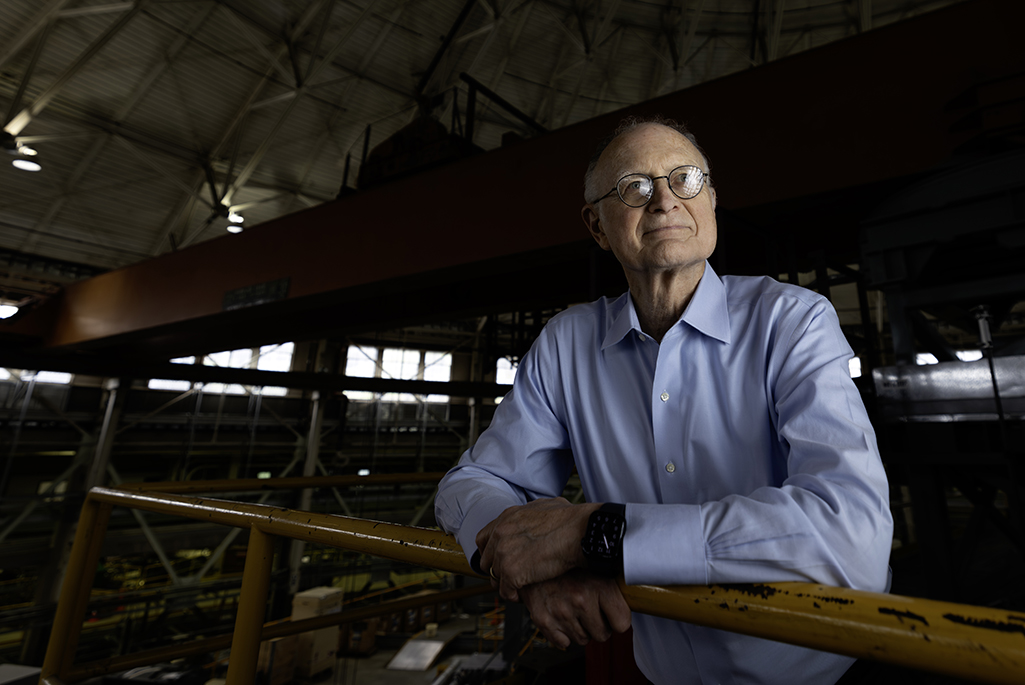
In this Q&A, Lab Director Mike Witherell shares his thoughts about the Lab’s current directions and its most urgent challenges – and how his transition from the Lab will unfold later this year. Chief Communications Officer John German conducted the interview.
For more, join Director Witherell during a State of the Lab town hall on Tuesday, April 7, from 11:00 a.m.-noon in the Bldg. 50 Auditorium or online at streaming.lbl.gov. He will highlight some of Berkeley Lab’s recent accomplishments and take questions from the online audience. Add this event to your calendar.
John German: Mike. Thank you for taking the time to share your thoughts. Let’s start with our research. We’ve experienced a lot of change over the last year in terms of shifting federal research priorities, some of which have become increasingly clear just in the last few months. We’ve also seen some of our long-term research priorities reinforced. What are the most important directions you’re seeing for our science mission?
Mike Witherell: I have to start with the opportunity that we have to explore how to accelerate science with AI, but it’s important to note that AI research is not new to Berkeley Lab. We’ve been supporting AI and machine learning projects since I arrived and even before that. We’ve been deliberately growing our capabilities, first with LDRD [Laboratory Directed Research & Development] and then with support from the [DOE] Office of Science as they started to fund small projects. That’s what our present-day expertise is built on.
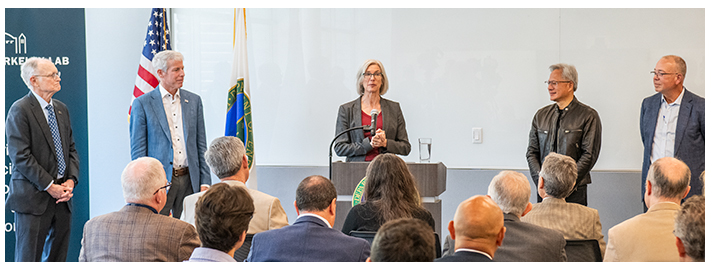
Jennifer Doudna, speaking at a news conference announcing the naming of the new NERSC-10 supercomputer as the “Doudna.”
Joining her, from left, Lab Director Mike Witherell, Chris Wright, Secretary of Energy, Jensen Huang, CEO, NVIDIA, and Paul Perez, Dell.
With the recent launch of the Genesis Mission, the national labs have been handed the extraordinary responsibility to lead a major federal initiative on AI for science. We’ve been preparing for it for years, both within the national lab system and at this Lab. I really think it’s going to be exciting.
A related point is how we manage data. The national labs and their experimental facilities are the best producers in the world of high quality scientific data, but we’ve not been investing in making sure that data is curated in a way that everybody can get the most benefit out of it. The limit to what you can do with AI and science is usually not the size of the AI model that you’re using; it’s usually the quality of the data set: how large and how complete it is, and how well curated it is. With AI, managing data in a standardized, curated way is suddenly a high priority for the national labs and the scientific community.
An example of this is our astronomical observatories. Instead of taking telescopes to look here and look there, we’re now taking surveys of the whole sky, such as with the DESI project. This mapping produces a deluge of data, which we have curated so that researchers around the world can mine it and make their own discoveries. This sort of standardized data management approach is now being expanded to light sources, to genomic science, and to other areas, and it is going to make the discovery faster, more efficient, and accessible to more researchers, especially when combined with AI.
“We need to understand that in the end, society is paying for the research enterprise. We will do well to figure out where the nation wants to go with this and be ready to pivot toward that. I think this is going to be a big challenge for all of the scientific community in the coming years.”
– Lab Director Mike Witherell
So if you ask me why the DOE national laboratories were assigned the role of leading the Genesis Mission? It’s because we have all the main ingredients needed to be successful: we have the computing power, we have unparalleled collections of scientific data, we have the world’s leading experimental facilities producing high quality data, and we have a longstanding commitment to serving the scientific community. It’s all those things, not just because we’re good at AI. We’re also the best source of data around.
German: Any recent research accomplishments you’d like to highlight?
Witherell:
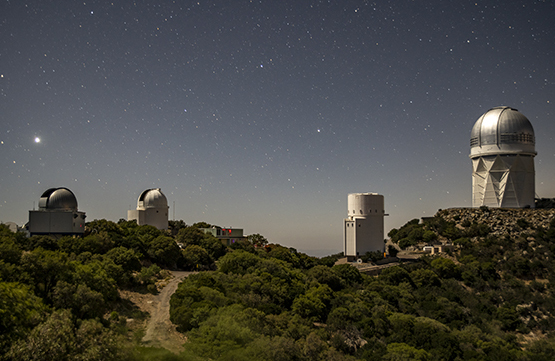
Kitt Peak National Observatory at night.
Sure. A recurring highlight is DESI, which keeps doing these wonderful things. The new round of DESI results are still thrilling to see. With the hints that dark energy might evolve, this project is changing how we see the universe. And the instrument has been incredibly efficient. DESI has already far surpassed the number of galaxies and quasars they planned to map during its initial five years of observations. In August, the American Astronomical Society chose the project for their big prize, the Lancelot M. Berkeley Prize, for advancing astronomy during the previous year. Astronomers don’t give these awards easily, and for a DOE laboratory-led project to do this is a real accomplishment.
An accomplishment in a completely different sphere is how we are having an impact on the energy industry. Our geothermal researchers worked with Fervo Energy to deploy an amazing borehole geophone at Fervo’s Cape Station development in Utah. This sensing device was operating more than a mile underground at 338 degrees Fahrenheit to look at geothermal reservoirs. How in the world do you build an instrument that can operate under those conditions? I still don’t understand that. I have to say that’s an amazing thing, but it’s not just gee whiz. They actually need it because very hot rock is the new frontier in geothermal energy. And the fact that Fervo Energy is a Cyclotron Road alumnus, that’s just a very satisfying collaboration for me.
Those are just a few recent accomplishments that have been on my mind. We have many impressive highlights from all over the Lab. I’ll be sharing more of those at my State of the Lab Town Hall on Tuesday, April 7, 11:00 a.m. – noon. Add this event to your calendar.
German: Thanks Mike. It’s been a difficult 12 months. The Lab experienced the first layoffs in many years in the fall as we adapted to shifting funding priorities in specific research areas and braced for lower overall spending, which reduced the indirect funds available to support Operations staffing. What’s your perspective on the fiscal outlook for the next few years?
Witherell: Yeah. As you said, we had to pivot quickly last year, and we had to make the painful decision to have the first broad layoff since I came to the Lab. For the previous 10 years we’d been through a period of steady growth every year, so the sudden change in direction was very difficult. I will say that our people did a lot of really great work to manage the situation, to see how we could minimize non-labor costs across the Lab and reduce Operations costs with a minimum number of layoffs. It was difficult to go through.
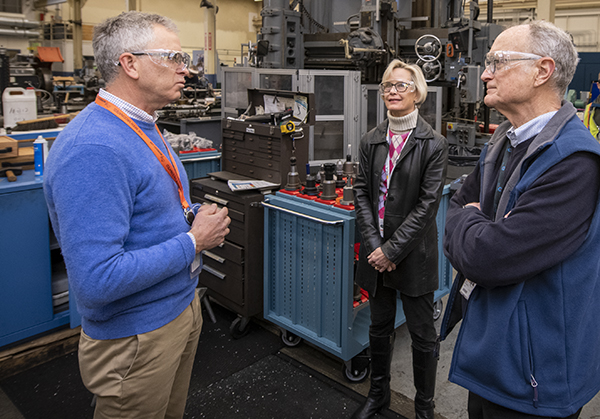
Henrik von der Lippe, former Division Director, Engineering, leads a tour of the Engineering facilities in Buildings 77 and 77A to show the new facilities and capabilities they are utilizing in the construction, verification, and implementation of new scientific equipment such as the ATLAS Detector, the Advanced Light Source Upgrade project with Lab Director Mike Witherell and Natalie Roe, Associate Laboratory Director for Physical Sciences.
But now as we look at this year, I think we’re actually pretty well prepared for what’s ahead. For one thing, it’s really good news that we got a DOE appropriations bill passed this fiscal year so we have much better certainty about the budget situation than we had a year ago. And generally, although there are pockets where this isn’t true, things are pretty stable across the Laboratory.
There are always going to be increases and decreases in various programs, but if we average what we’re seeing over the whole Laboratory, I don’t think we’ll be going through another round of broad Lab-wide reductions this year. And I have the sense that we’ll be able to sustain that pattern again next year as well, with no significant overall growth, but also no significant overall reductions.
German: This week you and Michael Brandt [Deputy Lab Director for Operations and Chief Operating Officer] are presenting our Lab Plan to our key program sponsors at DOE. What are you planning to convey?
Witherell: Every few years we prepare a report and give a slide presentation that summarizes our strategic plan for our DOE sponsors. This year, we’re giving the presentation first in Washington, D.C. The conversation with our sponsors that follows is usually the most interesting part of this process. That’s when we’ll learn more about how our sponsors view our strategic intent and what changes we need to make.
I’ll share what we learn at next week’s town hall. I hope people will tune in. Add this event to your calendar.
German: Some people have heard about an effort called Project Velocity. What is it, and why is it important?
Witherell: Project Velocity is a DOE effort designed to find places where there are barriers to the national laboratories doing their research effectively and efficiently. We all know there are those barriers. It’s not anyone’s fault. It’s just that over the years, more regulations are added, and as DOE orders accumulate they begin to restrict how we operate our business. And some of the regulations no longer provide any real benefit at all. And once in a while, DOE and the contractors take a close look at the regulatory framework for the national labs and see whether it should be updated. We’re in that mode right now.
The Project Velocity team within the Lab is working with subject matter experts – meaning mostly people involved in Lab Operations – to review these regulations and make recommendations about which ones might be removed from our contracts to streamline our operations and clear the way for a sharper focus on the research.
Right now, DOE’s Project Velocity team is going around to all the laboratories to talk to the people who are doing this work. Before any changes are implemented they will need to be incorporated into our contract. Then we would begin the difficult work of modifying our policies and practices to match our revised contract requirements. And so it’s an experiment that is just getting going. Our people are very much participating to help DOE be more successful.
German: The Lab has performed remarkably well in recent years by nearly all measures: Lab grades are up, the research portfolio has grown overall, budgets have generally increased despite short-term setbacks. What do you attribute that to? What’s Berkeley Lab’s secret sauce?
Witherell: People outside the Lab do ask me that question a lot. The answer is obvious; it’s the people we’ve been able to attract and retain, both in research and non-research positions. Our people are both very good at their jobs and they’re remarkably committed to the research mission. They want to work with other people who share that commitment. Very few institutions have so many people who are as well aligned and committed to the purpose of that institution as we do.
And the thing is, once you have people like that, they help attract more people like them. Ellen Ford [recently retired Operations Deputy] told a great story at her going-away party about how she came to be here. She said she was working at the GAP corporate offices in operations and someone came there from Berkeley Lab. And then, some months later, that person left the GAP to return to Berkeley Lab. Ellen asked her why she wanted to go back, and what she said was she really felt connected to the mission of the Laboratory. And sometime after that Ellen took her first job at the Laboratory. That’s how our recruiting should work.
In addition, I think we’ve done a good job of building a culture of stewardship so that everybody is ready to take responsibility for working together to advance the mission, and that’s what helps make this a great place to work.
German: You’ve announced your intent to retire later this year, and a search for your successor is under way. What can you share about this process and its timing?
Witherell:  I can say that the search is proceeding. As people here may know, the search committee was here at the Lab on December 19 to hear from a series of internal groups what they should be looking for in the next Lab Director. It was a very positive conversation. Right now the committee is in the process of interviewing a short list of final candidates. That’s about all I can share at the moment. It’s moving forward. I’m confident we will have an outstanding ninth Lab Director soon.
But I do want to say this so people understand how this typically gets announced at the end of the process: There will be a [University of California] Regents meeting where they will vote to approve the appointment. And that’s how the world will find out who the new Lab Director is going to be, including the people of the Laboratory. The next time when that could plausibly happen is the Regents meeting in May, and if they don’t vote on it in May, they’ll likely do it at the next one in July, and so on.
German: And what is your own timeline?
Witherell: Let’s see. I am committed to stay until there’s a new Lab Director ready to take over my office. And so I’ll be here until that time.
German: You’ve mentioned the long, fairly unusual period of leadership stability the Lab has enjoyed during your tenure? Recently, a number of people have announced their plans to step away, including Physical Sciences ALD Natalie Roe, Earth & Environmental Sciences ALD Bill Collins, and Deputy for Operations Ellen Ford. What are your thoughts about this period of transition? What does it mean for the Lab?
Witherell: I remember the day a few years ago now that we finally had a complete set of permanent ALDs, deputy directors, and chief officers at the Lab. And I have been pleased and surprised at how long that period of stability lasted. But almost as a function of the statistics of small numbers, after a period of stability you have a period of rapid change, and we’re in that now.
But I think it’s important to keep in mind that we have a remarkably strong set of leaders across the division directors and the top management positions. I think we’ve done a very good job of getting people who buy into the mission of the laboratory and who actively support our culture of stewardship. I think the next Lab Director will find that they’re very fortunate to be working with such a strong leadership team. And I think that will provide a level of stability to the Lab that is more significant than any one person leaving.
German: You’ve talked about this period in the Lab’s history as a time in which we’re doing great science while also preparing the Lab for the next era. Many capability upgrades and site modernization projects are well underway. What has already been accomplished, and what’s next?
Witherell: Yeah, I was thinking about this: We always need to be doing great science while working very hard to make sure we will have a laboratory capable of doing great science ten or twenty years from now. We’re not like an NBA team where we can tank for a season and then get a bunch of high draft choices to build our future winning team. That’s not how it works for a national lab. We always have to be doing high quality science and building for the future at the same time.

Two workers welding on top of a beam at a Lab construction project.
But doing great science just happens here because we’ve already collected those people, and we just let them go and they do great science. In some sense the work to build our talented team was done years ago and we’re now enjoying the fruit of that.
We’ve also made enormous progress over the last 10 years in preparing the laboratory of the future. During the pandemic we dug up a parking lot and turned that into two new buildings. As soon as we completed the IGB [Integrative Genomics Building], we started on BioEPIC, transforming the former site of the historic Bevatron into two impressive, modern research facilities. We’ve done major upgrades at NERSC and ESnet, and we’re getting Wang Hall ready for another NERSC upgrade, the installation of the Doudna supercomputer, later this year.
At the same time we’re building what will be a spectacular beating heart for the Laboratory, the Collaboration Commons, in the middle of campus. We’re well under way on the ALS-Upgrade, which will take a long time but will guarantee a 30-year future for one of the nation’s premier experimental facilities. And we’re on a multi-year campaign to renew all of the utilities infrastructure at the Lab. That’s enormous progress in a relatively short time. I am so thankful to the DOE Office of Science for demonstrating their confidence in our future by making these investments.
So we really couldn’t be in a better situation – a bright new set of facilities, laboratories, and even underground infrastructure – all complete in the next few years and ready to do great science for the long run. That’s our legacy for the future.
But we’re only halfway there. We will need some additional new facilities at our Charter Hill site as well as additional upgrades at ESnet and JGI to stay at the forefront of science. Those needs will be for my successor to advocate for.
German: What do you expect to be the Lab’s greatest challenges in the coming years?
Witherell: Well, zooming out, I’ve noticed that a conversation is just getting started about the national research enterprise and what it should be. What’s the right balance between basic and applied science? Should more research be focused on specific national challenges as opposed to curiosity driven research? What should be the federal government’s role compared to industry’s role compared to philanthropy’s role? Who should receive the benefits from research? And who should be making these decisions? I can see these questions bubbling up in many places, including in my work with the National Academy of Sciences. And I suspect the final answers to those questions will not result in the same old thing this time.
So the national research enterprise will be evolving, and the institutions that are in a position to change with it will do the best. We will be called on to adapt to these changes in certain ways. We need to understand that in the end, society is paying for the research enterprise. We will do well to figure out where the nation wants to go with this and be ready to pivot toward that. This will be a challenge that we will be going through, that medical schools will be going through, that engineering schools will be going through. I think this is going to be a big challenge for all of the scientific community in the coming years.
For us, it’s important to remember that the thing about any transition is you can’t plan exactly what’s ahead and how it’s going to play out. In the end, what are the assets you bring to the table? We will need to keep our focus on having the right people in place and the right culture for the Laboratory. We need to keep our focus on excellence and the shared mission of the Laboratory, even as it shifts. That’s the best you can bring to it. That’s how to keep doing great science no matter what is presented to us.
German: When you think about your 10-year tenure as Lab Director, what are some things you’re most proud of?
Witherell: Well, it’s been the privilege of my working life to have been Lab Director at Berkeley for these ten years. I often say to people, including my colleagues at the National Academy, that it’s the best job in the country for someone who wants to have an impact on science and technology. So I’m most proud of this Lab’s scientific accomplishments, and we’ll talk more at the April 7 town hall about many of those.
As proud as I am of all the scientific accomplishments, recently I’ve been thinking about how satisfying it has been to see such a rapid improvement in our performance, especially in Operations. When I visited DOE at the start of my term, a lot of our sponsors told me “you do great research out there, but you need to do better at operations.” It was fairly consistent, and so I took that to heart.
 Michael Brandt and I have brought in an extraordinary set of Operations leaders, and together they have worked to become one of the best Operations teams in the DOE complex. The last few years our Operations grades are best in class. Our safety record is one of the best around. We’ve been able to get these buildings built on time and on budget. And most importantly, we’ve earned the trust of our sponsors.
So those same DOE sponsors today are saying “you are the examples that we talk to people about.” When a new lab director comes in, our sponsors say “go look at how Berkeley is doing this.” And so I’m actually quite proud of that. It’s not just that we’re doing the research as well as we can. It’s the trust in how we get things done that keeps our sponsors investing in new facilities here. I think that has had more to do with why the Office of Science has supported us than anything else. So I’m proud of that.
German: You didn’t mention the culture of stewardship that has been one of your priorities during your tenure. How can we make sure that’s a permanent feature of the Laboratory?
Witherell: Right. As everybody knows, I like to take walks around the Lab at lunchtime. It’s been interesting that since I announced that I would be stepping down this year, more people have come up to me to talk during these walks. People I haven’t met often introduce themselves and say how much they have appreciated my leadership at the Lab, how they feel that I have helped make it a great place to work and how they feel connected to the Laboratory. I find these to be very gratifying reminders that people care about the culture of respect, trust, team science, service, and innovation we have built here together.
And many people still talk about how we took care of the Lab and each other during the pandemic. One person told me last week that at a time when she was not hearing anything useful from governments or other institutions about what was going on with the virus, she appreciated hearing from me. She said that she would show the videos I made to her children, saying, “This is someone in a position of leadership who is able to communicate to people in a way that helps them.”
This kind of feedback is not only wonderful to hear. It also makes me think that people really have been paying attention to this and that our stewardship culture has been having an impact on people. And I’m actually quite confident that this is something that will continue to serve the lab well for time into the future.
German: Your term here as a national lab director hasn’t been your first experience in leadership. You’d already been Lab Director at Fermilab and vice chancellor for research at UC Santa Barbara before you came here. If you look back on the last 10 years at Berkeley Lab, what surprised you the most?
Witherell: I’m going to turn it in a slightly different direction and ask “how is it different being a lab director the second time compared to the first time?” And the fact is, the first time I was Director at Fermilab, I knew a lot about high energy physics, and I’d been chair of all the committees, all that stuff. But I really didn’t know anything about leading an institution. I had some great help from people who were there, but I came in new to that and was to a great extent learning on the job. And then I had my time at UCSB where I learned about a much broader set of fields than just physics.
So I was a lot better prepared for this position this time around. That was the main difference. Part of that was having enough experience to know that I couldn’t micromanage the strategic direction of all the different research areas of the Laboratory. There were ALDs who were going to be good at that. But what knits together the Laboratory into a fabric, into a community, that’s what I knew was important for me to focus on.
So that was the thing that was really different this time. What I did the first year or two here is mostly listen, learn about the Lab, learn about the people, see what was already here, which was really quite remarkable. And then think about how to knit it together. And thinking about that led to a focus on communication, and stewardship, and the shared purpose that brings us together. So that was something I had learned from those previous years, so I could come in and hit the ground running and say “here are some things I want to do during the time I’m here.”
German: What are you looking forward to personally?
Witherell: First of all, sometimes people say they’re retiring and they get to relax a little bit. For me this is the busiest time I’ve had here, right now. So I don’t spend a minute actually planning what I’m going to do when the time comes.
But I’m looking forward to, certainly, having some time with my family that isn’t just me rushing out the door or being dead tired at the end of the day. I’m looking forward to that.
I talked about the conversation that’s underway on how the scientific enterprise is changing. I think I will probably be asked to continue some responsibilities with the National Academy of Sciences on this topic because I think there’s a lot going on there that I have something to contribute to, and I’m quite concerned about it. And so I’ll be looking at that.
But mostly, after things end here, I’ll be trying to figure it out. The pattern of my career has been that every 10 years I get thrown into something completely new and I have to learn about it. Mostly what I’ve been doing all this time at Berkeley Lab is learning about all these different fields of research, and it’s been great. Now I’ve got to figure out what to do next when I get there.
German: Thank you, Mike.
