
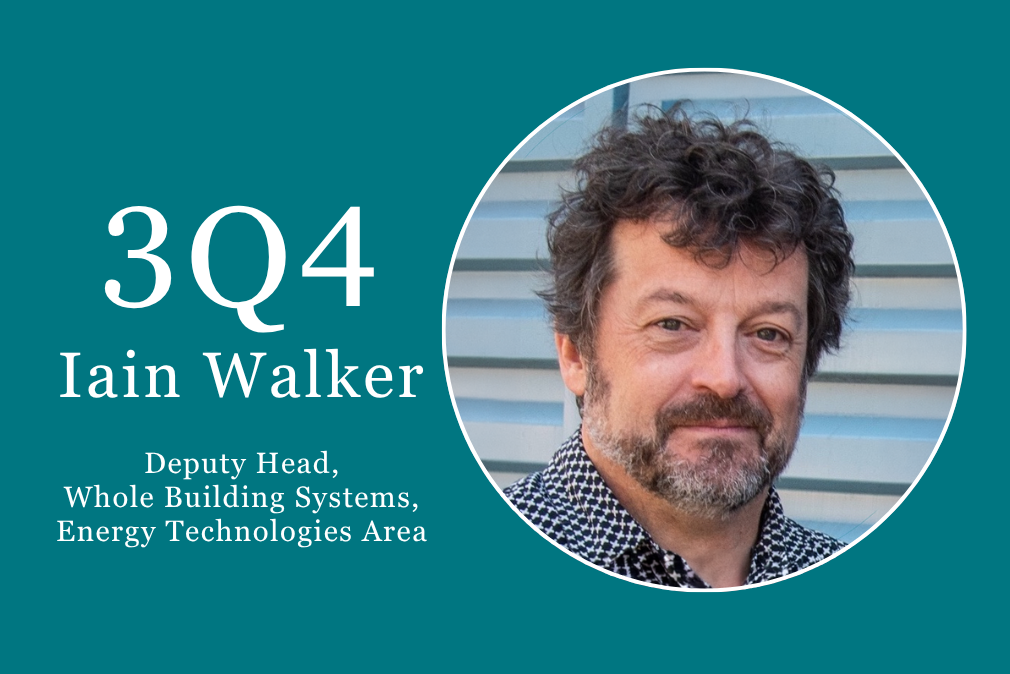
For 31 years, Staff Scientist Iain Walker has studied how air moves through buildings; a path that actually began with fluid mechanics research, then combustion engines, before a project on building safety during oil well blowouts redirected his focus. Now Deputy Head of the Whole Building Systems Department, Walker’s long career was recently recognized by the American Society of Heating, Refrigerating and Air-Conditioning Engineers (ASHRAE), which awarded him its Donald Bahnfleth Environmental Health Award and Exceptional Service Award.
Can you describe the core focus of your research at the Lab? What challenges are you addressing?
I’ve always worked primarily in residential buildings, and I lead the residential team here at the Lab, though it’s very much a team effort, with collaboration across several divisions within ETA. Our core sponsors are the Department of Energy, the California Energy Commission, NYSERDA, and we occasionally work for utilities, but my current work breaks down into two core areas.
The first is airflow in buildings and its consequences for energy use and indoor air quality. Right now that includes urgent DOE work on wildfire smoke, developing guidance for homeowners facing hazardous outdoor air. Another thread is the non-energy impacts of home retrofits. Insulating, air sealing, or upgrading windows doesn’t just lower bills. It can improve comfort and performance. We’re now developing metrics to quantify these benefits.
The second area is new: power efficiency. It grew out of research into avoiding the cost of replacing electrical panels and utility connections during retrofits, but it’s become bigger. We already know how to build energy-efficient homes. The harder challenge is building low-power homes: reducing peak electricity demand to ease grid stress. Lowering peak power cuts the need for costly new utility infrastructure and allows more homes to be built using existing grid capacity.
How does your research make its way out of the Lab and into people’s everyday lives?
A lot of it comes down to collaboration with the building industry and providing technical and leadership support to home performance-related professionals, nationally and internationally. ASHRAE is a big part of that, but we also work with International Energy Agency Annexes, American Society of Testing and Materials, the International Electrochemical Commission, and RESNET (Residential Energy Services NETwork), the national home energy rating organization. We’re helping develop guidelines for better building practice and provide test methods and metrics to improve building performance. We’re working with industry to figure out how to make better products, and making sure they get credit for it.
In terms of everyday lives, the work we’ve done on sealing up homes and ducts has cut people’s energy bills by roughly a third. And the indoor air quality work has made homes substantially more comfortable to live in.
I’ve also given probably hundreds of workshops and presentations over the years to industry leaders and practitioners, providing guidance and lowering the barriers to adopting new ideas. But it’s also a two-way street. I get direct feedback from people in the field about what’s actually working, and the problems they are facing, which feeds right back into the research.
You’ve been recognized by ASHRAE for your volunteer service. How does that volunteer work feed back into your research here at the Lab, or vice versa?
ASHRAE is the professional organization responsible for how buildings are heated and cooled, and more broadly for energy performance, indoor air quality, and ventilation. I joined it early in my career to meet other people doing this work and to make sure my research would have real impact. It’s the bridge between the detailed, fundamental physics we do at the Lab and practical, actionable information for the engineers and trades actually building and operating these systems.
For young researchers especially, finding an organization like this is invaluable. It connects you to what’s happening outside the Lab and to industry practitioners who can tell you what problems actually need solving. I think it’s a mistake to do research in a bubble. Talking with people who don’t always agree with you, hearing what manufacturers or engineers are struggling with in the field, helps you understand the next big problem in your area. That’s exactly the kind of practical grounding DOE wants when they ask about the impact of our research or where the field needs to go next.
ASHRAE has also given me leadership experience that translates directly into running research teams at the Lab and collaborating with sponsors and outside agencies. Organizing strong-minded people toward a shared goal is a challenge whether you’re chairing an ASHRAE activity or managing a project at LBNL. The skills transfer both ways.
There’s also a more philosophical lesson in it: it’s almost inevitable that someone else has already thought about the problem you’re working on. Staying engaged with a professional community, and reading as widely as you can in the literature, keeps you humble. As researchers, we can develop a lot of ego about our own ideas, but real progress means questioning your assumptions and recognizing you’re not the only person who’s thought seriously about any particular problem.
