Berkeley Lab’s Advanced Light Source (ALS) has been a global leader in soft X-ray science for more than three decades. As a U.S. Department of Energy (DOE) Office of Science user facility, it supports researchers across the Lab and international science community seeking to better understand material properties and chemical reactions. A multi-year project to modernize the facility, known as the Advanced Light Source Upgrade or ALS-U, is underway to increase the brightness and coherent flux of the ALS’ soft X-ray beams by at least a hundredfold.
The ALS-U recently received the green light from DOE on a revised cost and schedule for the project, paving the way for enhanced capabilities and AI-driven optimization that will drive new discoveries in fields like materials science, microelectronics, quantum systems, biology, and energy technologies.
What to Expect
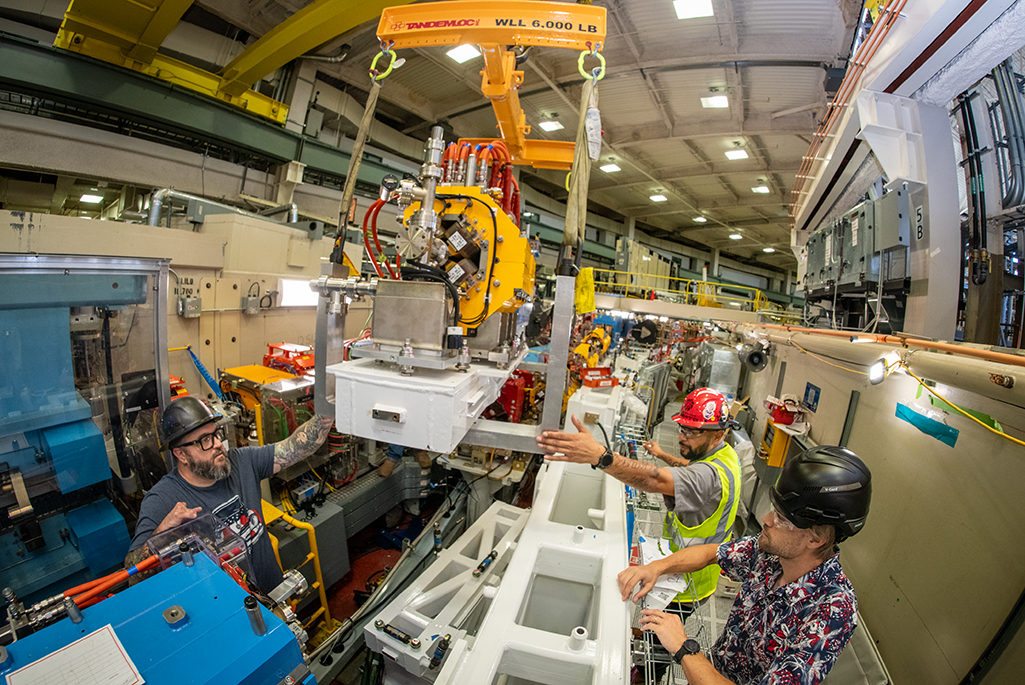
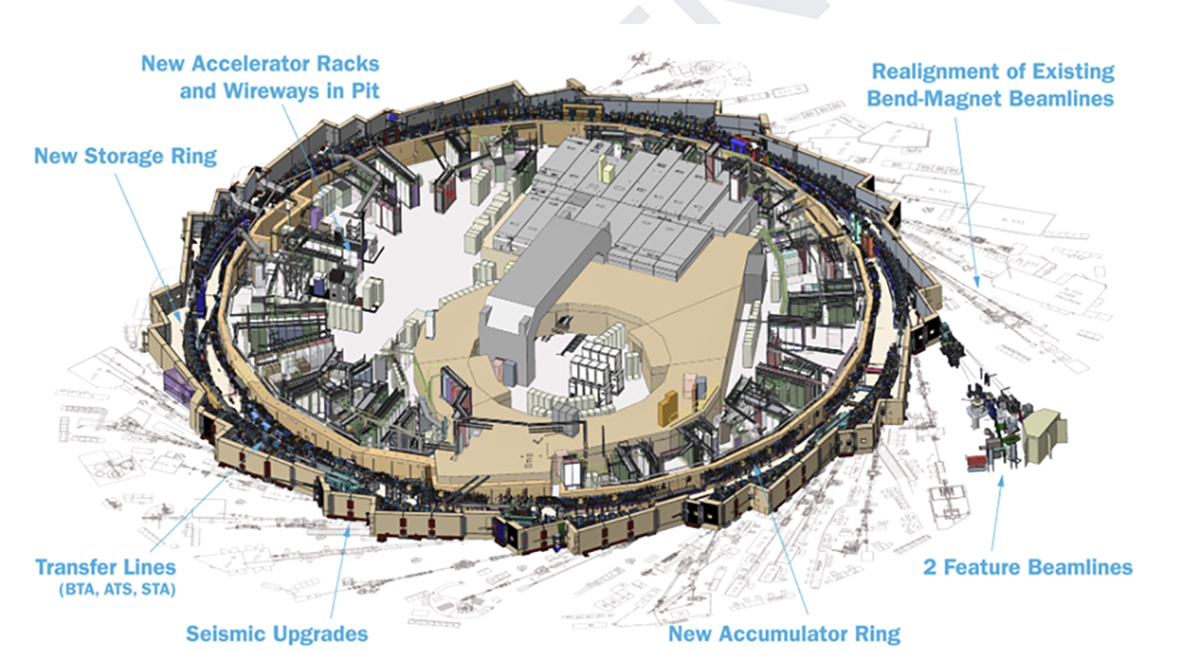
The ALS is progressing toward this major facility upgrade, with key construction milestones underway and completion projected by the end of 2029. Recent achievements include installation of magnets and other accelerator components for the accumulator ring — one of the two accelerators being built — and production approval of magnets for the new storage ring, the second accelerator. These new higher performance magnets steer and focus the electron beam; arranged in a specific way called an accelerator lattice, they substantially reduce the beam size and generate brighter light for examining materials in greater detail.
The project not only provides a much-needed upgrade to the accelerator that powers all of the ALS but will also include two upgraded feature beamlines that will allow higher throughput materials experiments and extend data outputs of complex structures from 2D images to 3D tomographic views and high-speed dynamic maps, and open new frontiers in quantum materials research. All major optical systems for both beamlines have been received, tested, and accepted.
With the accumulator ring magnet lattice and vacuum systems already constructed, achieving first light now requires the installation of over 3,000 cables and infrastructure of the radiofrequency cavity amplifiers. The team made significant progress during 2025 and will continue integrating the accumulator ring with other systems while the ALS is temporarily shut down this summer. Key preparation work is also underway in parallel to support accumulator ring commissioning in spring 2027 and later storage ring construction.
As part of these preparations, the ALS will replace its aging main electrical switch station this summer, as it has reached the end of its operational life. The facility will shut down for approximately six months, beginning in July 2026, and return to user operations in January 2027. During this period, crews will also install a permanent hatch in the flat part of the roof adjacent to the facility’s historic dome-shaped building to support ongoing upgrade access — particularly for removal and installation of accelerator tunnel roof blocks — with a semi-permanent crane positioned between Buildings 58 and 6. Safety and access information and user operations will soon be made available on the ALS website.
Following this work, the facility will enter “dark time” — a roughly 22-month period, beginning no earlier than fall 2027, during which the existing storage ring will be replaced with the new, high-performance system. Until then, the ALS will sustain user operations to maximize scientific output during the transition. Project completion is targeted for the end of 2029.
“Navigating the complexities of a project of this scale requires tremendous collaboration,” said Dimitri Argyriou, interim ALS-U Project Director and ALS Director on leave. “This upgrade will ensure we provide the scientific community with the latest X-ray technology to continue their research for decades to come.”
New Leadership
Over the past 18 months, the ALS-U has recruited experts from around the Lab and broader scientific community with experience in project management, large-scale accelerator upgrades, design, and engineering to move the project full steam ahead. The most recent addition is Greg Hays, who joins the team as ALS-U’s new director.
 Hays has over three decades of experience leading complex science infrastructure programs across the DOE’s National Lab complex and has delivered large-scale, multi-laboratory projects. Prior to this, Hays served as Project Director for SLAC’s LCLS-II and LCLS-II-HE projects, two of the most complex accelerator facilities in the world.
Hays joins an established leadership group that includes Dimitri Argyriou, who served as Interim Project Director of the ALS-U since January 2025 and has led the team through to its most recent phase. Andreas Scholl served as Interim ALS Director, steering the user facility and its community through these transitions. Starting July 1, Argyriou will support Hays’ onboarding while returning to the ALS as its Director, and Scholl will return full-time to his role as ALS Deputy for Science.
“We are incredibly grateful to Dimitri Argyriou for his outstanding stewardship as Interim Project Director during this critical transition. His leadership has been vital in keeping the ALS-U project on a successful trajectory,” said Interim Chief Research Officer Jeff Neaton. “And as we enter this exciting next chapter, I also want to extend a warm welcome to Greg as our new Project Director. Greg brings a wealth of experience that will be invaluable as we bring this upgrade of a world-class facility to fruition.”
“Berkeley Lab and the Advanced Light Source have a distinguished scientific heritage. I am honored to steward the ALS-U project into its next phase and work with the team to drive this historic modernization to a successful completion,” said incoming ALS-U Project Director Greg Hays.
Scientific Promise of ALS-U
For decades, the ALS has enabled key breakthroughs in microelectronics, quantum computing, vaccine discovery, cancer treatments, energy, and our understanding of the universe. It has contributed to five Nobel Prizes and serves roughly 1,600 researchers annually from almost all 50 states and across academia, industry, and the national laboratory complex.
The historic upgrade will unlock new scientific insights by allowing deeper explorations, more data capture, and the observation of processes never seen in real-time at the nanoscale. AI-driven automation and high-throughput experiments will be built into the modernization, allowing for faster and more accurate analyses.
The vast amount of high-resolution data produced at the upgraded ALS will serve as an incredibly valuable resource for training AI models to understand new materials, chemical reactions, and biological systems. Such AI-driven scientific discovery will pave the way for advancements in quantum computing, microelectronics, medicine, and battery design.
“The Advanced Light Source has long been a powerhouse of discovery, and this upgrade marks the beginning of a transformative new chapter for Berkeley Lab and the broader user community,” said Lab Director Mike Witherell. “By unlocking unprecedented resolution and integrating real-time AI analysis, we are equipping the scientific community with the tools needed to pioneer entirely new fields of research. This modernization is not just an investment in our infrastructure, but a commitment to our mission of providing science solutions to the real-world challenges faced by people and the nation.”
