What do you do at Berkeley Lab?
I am a research scientist in the Energy Geosciences Division, which is part of the Earth and Environmental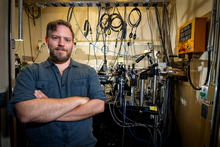 Sciences area. I run a rock physics lab, which is a lab we use to characterize the physical properties of rocks and minerals. The field I work in is called geophysics. A lot of geophysicists either work in the field—putting sensors out, trying to image what’s going on deep underground and understand large-scale processes—or they work computationally, running models that incorporate complicated processes.
A mentor of mine once described me, quite accurately, as an “indoor geophysicist.” Instead of hiking around and planting seismometers on mountainsides, I’m in the lab doing careful measurements of things that we later use to interpret that large-scale data. The work ranges from very fundamental—understanding how minerals, rocks, and the pores inside rocks change with varying conditions—all the way to highly applied projects involving geological storage of hydrogen or CO₂, geothermal energy, and fundamental earthquake processes.
You are being honored for your outreach activities. How did you get involved in outreach?
At the most basic level, it’s because I’m excited about science and like to share it. Over the years, I’ve recognized that the hardest part of running a successful research program—whether that’s one PI’s lab or the big “capital L” lab we work at—is having the people to do the work. Research can be esoteric, and it’s not something many younger students are even aware of. But, in my experience, every time you share the work, some students are excited about it. The earlier students can learn that people are asking fascinating questions and using cutting-edge techniques to answer them, the more future researchers you get involved early.
Running my rock physics lab is my main job, but I also work extensively at the Advanced Light Source (ALS), where Earth Sciences runs our own beamline. We’ve developed a unique microscope for high-resolution 3D imaging of tiny structures, and part of our agreement with ALS is to support other researchers wanting to use this instrument.
This generates a different kind of outreach—inviting and collaborating with external researchers who may not even know the capability exists.
How has your outreach involvement helped you, either personally or professionally?
Outreach is just enjoyable. At the heart of it, your daily work experience is shaped by the people you interact with, so interacting with students is energizing and fulfilling. It also breaks up the drudgery of emails and routine tasks. Intellectually, working with students helps identify gaps in your own understanding. When you try to explain something to someone else, you realize your assumptions or conceptual models might not be as sound or clear as you thought. So, beyond being fun, it’s a way to clarify your own ideas and grow as a researcher.
How do your efforts contribute to the Lab’s mission or culture?
One obvious way this supports the Lab’s mission is through team science—one of our core values. Team science requires a team, and bringing in junior researchers creates mutually beneficial situations. Students gain training, exposure to cutting-edge data and techniques, and professional development opportunities. In turn, they help accomplish research tasks that cannot easily be outsourced to AI or automated systems, because they require human judgment and context awareness.
This is also stewardship. If we want the Lab to remain successful in the future, we must invest in building the workforce for it. That training might directly prepare interns for graduate school or research jobs. I also participate in STEM events with local schools—sometimes it’s as simple as showing volcano pictures to 10-year-olds and explaining they could work on this stuff someday. Research is niche, so the funnel must be wide at the start: forty kids loving volcanoes might result in ten undergraduates, two graduate students, and ultimately one scientist.
What was your reaction when you were told you were receiving a Director’s Award?
When I was told I was receiving a Director’s Award, I was flattered. Working with students is an integral part of my research. Working with 3D datasets from the ALS provides lots of bite sized projects that students can quickly engage with, and many students help directly with my projects by analyzing data or tackling other critical tasks. I hadn’t thought of it as going above and beyond my job. But I recognize not every researcher is inclined to involve students, and part of my ability comes from the nature of my work.
Are you bringing anyone special to the ceremony?
I have a three-year-old daughter, and possibly my wife and daughter will attend. I think that would be fun. She’s been to the Lab one other time. She came the day before the holiday shutdown last year, and she still talks about it and asks if she can come to my office.
