On Nov. 24, the Department of Energy announced the Genesis Mission, a national initiative to advance artificial intelligence in order to accelerate scientific discovery and deliver solutions to America’s challenges in science, energy, and national security. The Genesis Mission aims to develop an integrated platform that connects the world’s best supercomputers, experimental facilities, AI systems, and unique datasets across every major scientific domain with the goal of doubling the productivity and impact of American research and innovation within a decade.
As part of the Genesis Mission, a set of initial projects, sometimes referred to as “seed projects”, has been launched to jumpstart the development of AI models to accelerate discovery and innovation.
Berkeley Lab is leading or playing a key role in three of these projects, listed below, which are focused on harnessing AI to accelerate discoveries related to particle accelerators, X-ray and neutron user facilities, and biotechnology. Berkeley Lab is also contributing to other projects focused on AI code development, critical minerals and materials, cosmology, microelectronics, and quantum algorithms. The Lab’s contributions to the Genesis Mission build on decades of research in high-performance computing, managing large datasets, and pioneering AI models that yield insights across many science domains.
MOAT: AI for smarter, more powerful, and more efficient accelerators

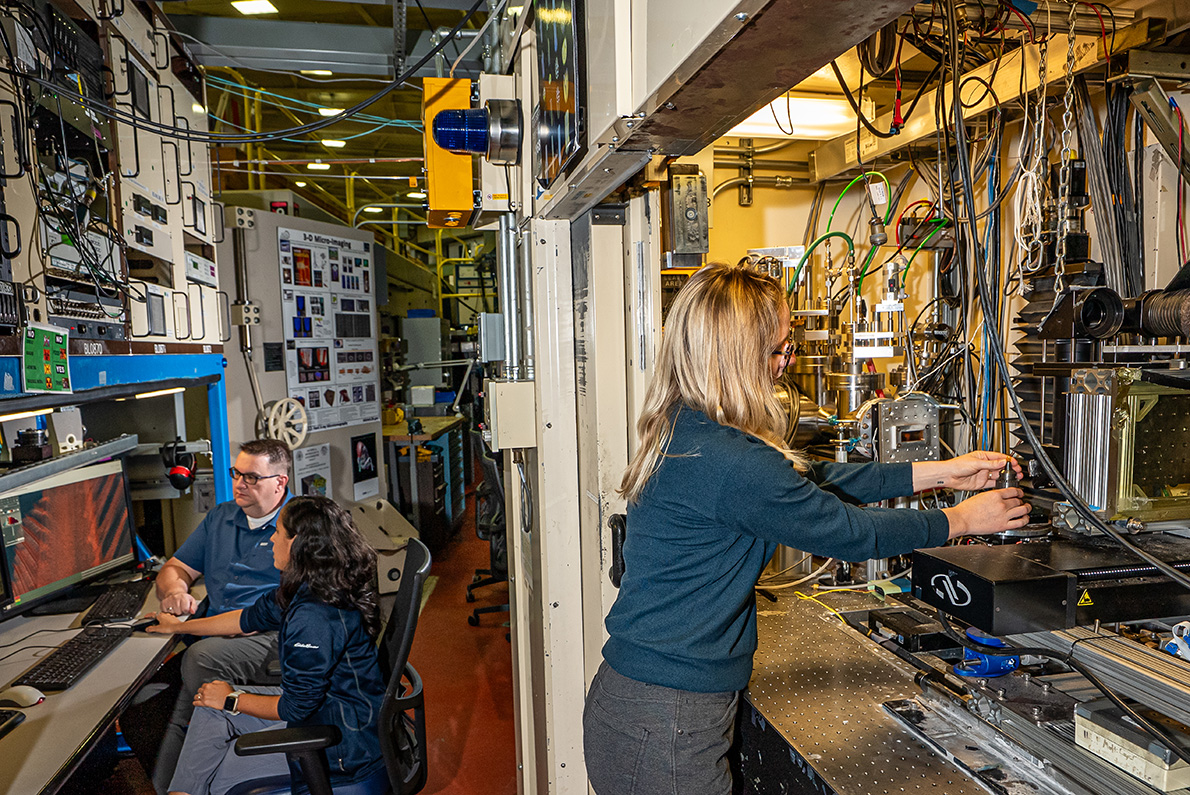
Researchers align precision optics to prepare the Berkeley Lab Laser Accelerator (BELLA) Petawatt laser for laser-plasma accelerator (LPA) experiments. The machine learning–based control algorithm stabilizes the high-power laser’s pointing at the LPA target.
Particle accelerators are powerful tools. They’ve revolutionized research in physics, chemistry, materials science, and biology, and been adopted for applications that improve medicine, national security, and manufacturing. The Multi-Office particle Accelerator Team (MOAT) will deploy AI tools to optimize how accelerators are designed and run, making them more powerful and efficient, speeding progress on national priorities.
The project will take advantage of troves of experimental data, simulations, and expertise from across the DOE Office of Science’s accelerators and light sources, which account for half of the agency’s user facilities. MOAT will build and expand tools like digital twins, intelligent assistants, and advanced AI models that can represent complex accelerator physics and operations. It will also make them platform agnostic – so shared knowledge and improvements can be adopted by national labs, universities, and industrial partners.
“By making intelligent AI tools that continuously learn and work across facilities and fields, we’re accelerating discoveries that particle accelerators can make in key applications such as fission and fusion energy, advanced materials, fundamental physics, and advanced medical technologies,” said Jean-Luc Vay, MOAT’s lead and the head of the Advanced Modeling Program in the Accelerator Technology & Applied Physics Division.
MOAT currently includes partners from Argonne, Brookhaven, Fermi, Jefferson, Oak Ridge, and SLAC national laboratories, as well as industrial partners at Advanced Micro Devices, Kitware, Nusano, NVIDIA, Radiasoft, and Xlight.
SYNAPS-I: An AI platform for accelerating discoveries at advanced light and neutron user facilities
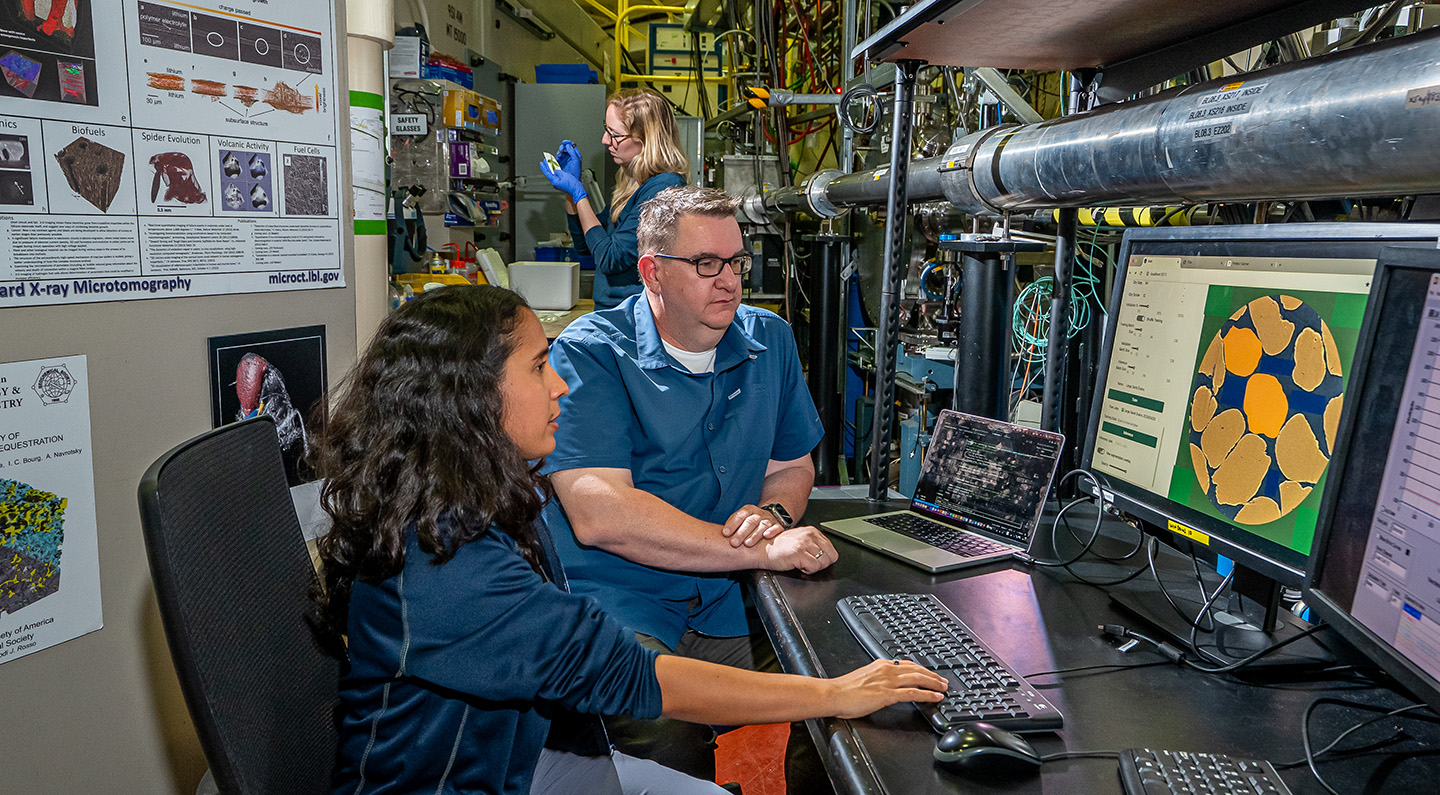
Alexander Hexemer, Tanny Chavez, and Liz Clark pictured at the ALS microtomography beamline with an AI-driven web interface that will be leveraged by SYNAPS-I.
Breakthroughs in microelectronics, medicine, advanced manufacturing, and energy security are critical to ensuring our national security. Leading X-ray and neutron user facilities in the U.S., including Berkeley Lab’s Advanced Light Source (ALS), are crucial tools for advancing these fields, and mining the vast datasets they capture on material properties and chemical reactions will yield even more discoveries.
A multi-lab initiative called SYNAPS-I (Synergistic Neutron and Photon Autonomous Science – Imaging) could accelerate breakthroughs by making discoveries from unprecedented volumes of data. Working directly with industry partners, SYNAPS-I will transform petabytes of imaging data into actionable knowledge, demonstrating AI-accelerated advanced discovery capabilities that can be applied to critical technologies.
The SYNAPS-I platform will integrate foundation models across all participating light and neutron sources, enabling unified analysis of imaging data from cutting-edge X-ray and neutron instruments at seven DOE Basic Energy Sciences user facilities, including the ALS, a synchrotron light source that produces X-ray, ultraviolet, and infrared light. The increased data outputs of recently completed and in-progress facility upgrades, such as the ALS-U project, bring even greater opportunities to accelerate scientific discovery across a wide range of disciplines.
“By working together on AI, we will build cross-facility capabilities that enable our users to unlock and accelerate scientific discovery from unprecedented data quality and output,” said Alex Hexemer, ALS senior scientist and SYNAPS-I lead point of contact.
“SYNAPS-I marks the first step into an exciting new era for science at modern facilities. With the ALS — especially after the ALS-U upgrade — we’ll gain an unprecedented view into the inner workings of nature and technology. The challenge lies in turning that immense detail into knowledge that advances humanity. SYNAPS-I begins this next chapter of discovery,” said Dimitrios Argyriou, Interim Project Director of Berkeley Lab’s Advanced Light Source Upgrade Project (ALS-U).
SYNAPS-I includes partners from Berkeley Lab, Argonne National Laboratory, Brookhaven National Laboratory, SLAC National Accelerator Laboratory, and Oak Ridge National Laboratory.
OPAL: Establishing an AI-enabled autonomous biodesign infrastructure to accelerate biological science discovery
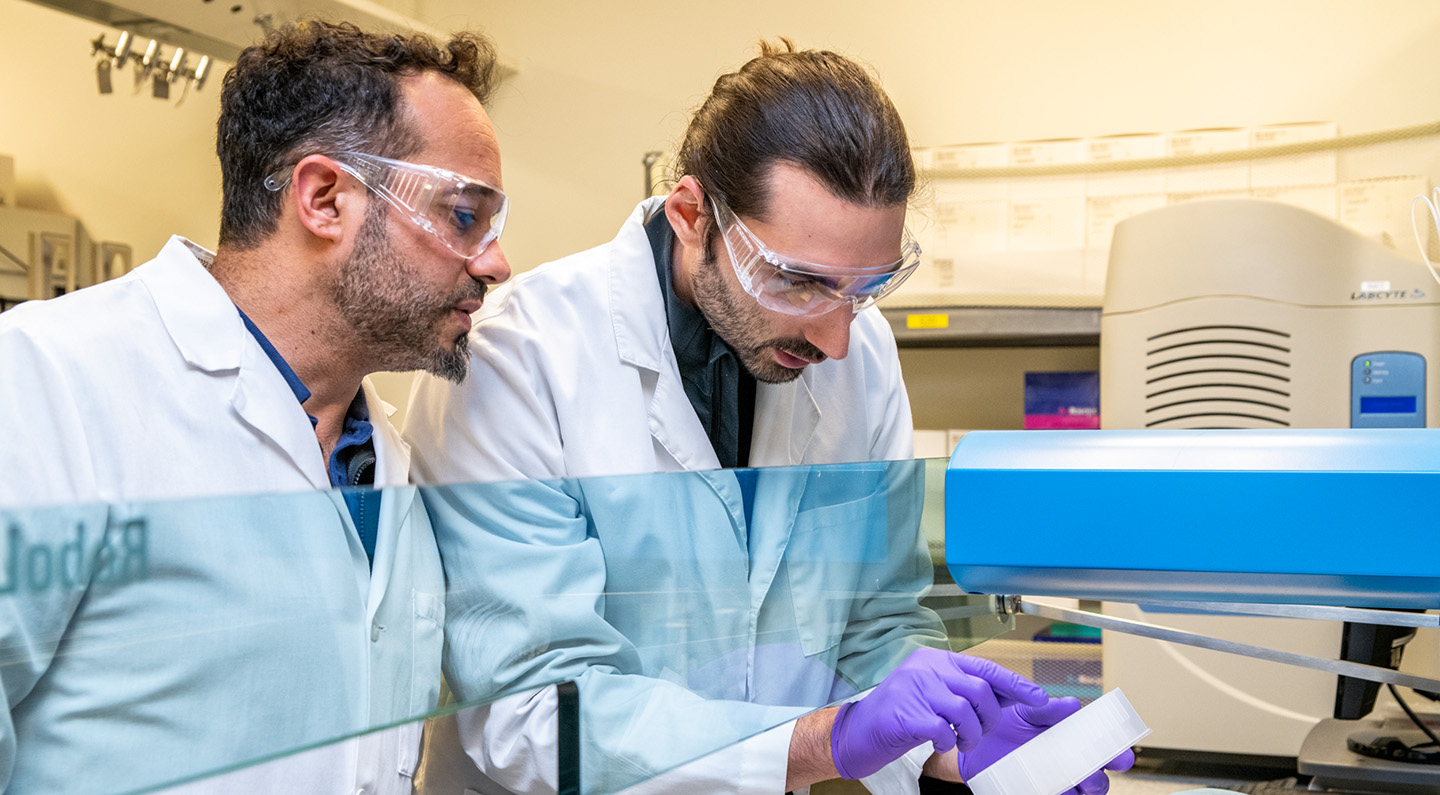
Hector Garcia Martin and Zak Costello have developed a new machine learning approach that could accelerate bioengineering.
Researchers from four national laboratories and industry are collaborating to unleash the full potential of biology for manufacturing fuels, chemicals, and consumer goods, and to harness biological systems as tools for agriculture and critical mineral recovery. The Orchestrated Platform for Autonomous Laboratories to Accelerate AI-Driven BioDesign (OPAL) project is using robotic systems, AI agents and models, and standardized data-sharing platforms to accelerate the biotechnology pipeline all the way from gene discovery to commercialized technology, helping the nation meet urgent energy, and supply chain challenges.
The OPAL team’s Genesis seed project will develop powerful, general-purpose biology AI models, called foundation models, that can be tailored for specific applications with additional training and eventually control AI agents to manage investigations autonomously. OPAL’s Berkeley Lab members are focused on foundation models for microbial engineering that link genes to their function in an organism and on building capabilities to integrate models with automated laboratory tools. These contributions will allow scientists to quickly perform experiments that would otherwise take weeks, months, or even years, alleviating traditional bottlenecks in the R&D and scale-up phases.
“OPAL is at the forefront of changing how we do biological research, using advanced AI methods to dramatically improve our understanding of biological systems, but to realize that potential we need to collect significantly more data, and AI can help us do that smartly,” said Paul Adams, Associate Laboratory Director for Biosciences and OPAL lead point of contact. “The foundational genomic models from our seed project will have broad application, from critical minerals to high-performance jet fuel precursors, helping to transform biotechnology and industrial processes.”
The project includes scientists and engineers from Oak Ridge, Argonne, and Pacific Northwest national laboratories and planned collaborations with Teselagen and FutureHouse. OPAL is supported by DOE’s Office of Biological and Environmental Research (BER) and Advanced Scientific Computing Research (ASCR) programs.

2 Comments
It’s particularly encouraging to see the deeply collaborative model at the heart of the Genesis Mission’s seed projects. Each initiative whether focused on accelerators, light sources, or biology brings together multiple national labs, universities, and crucially, industrial partners like NVIDIA, AMD, and various biotech firms.
This is an incredibly exciting and ambitious initiative. The Genesis Mission articulates a powerful vision for the 21st century: seamlessly integrating the world’s most advanced supercomputers, AI systems, and experimental facilities into a unified discovery engine. The potential to double the impact of American research within a decade is not just a goal; it’s a necessity for tackling complex global challenges.