Round or square buttons in the UI design? Orange or blue?
Sometimes, these are the things that take 30 emails and still have no resolution.
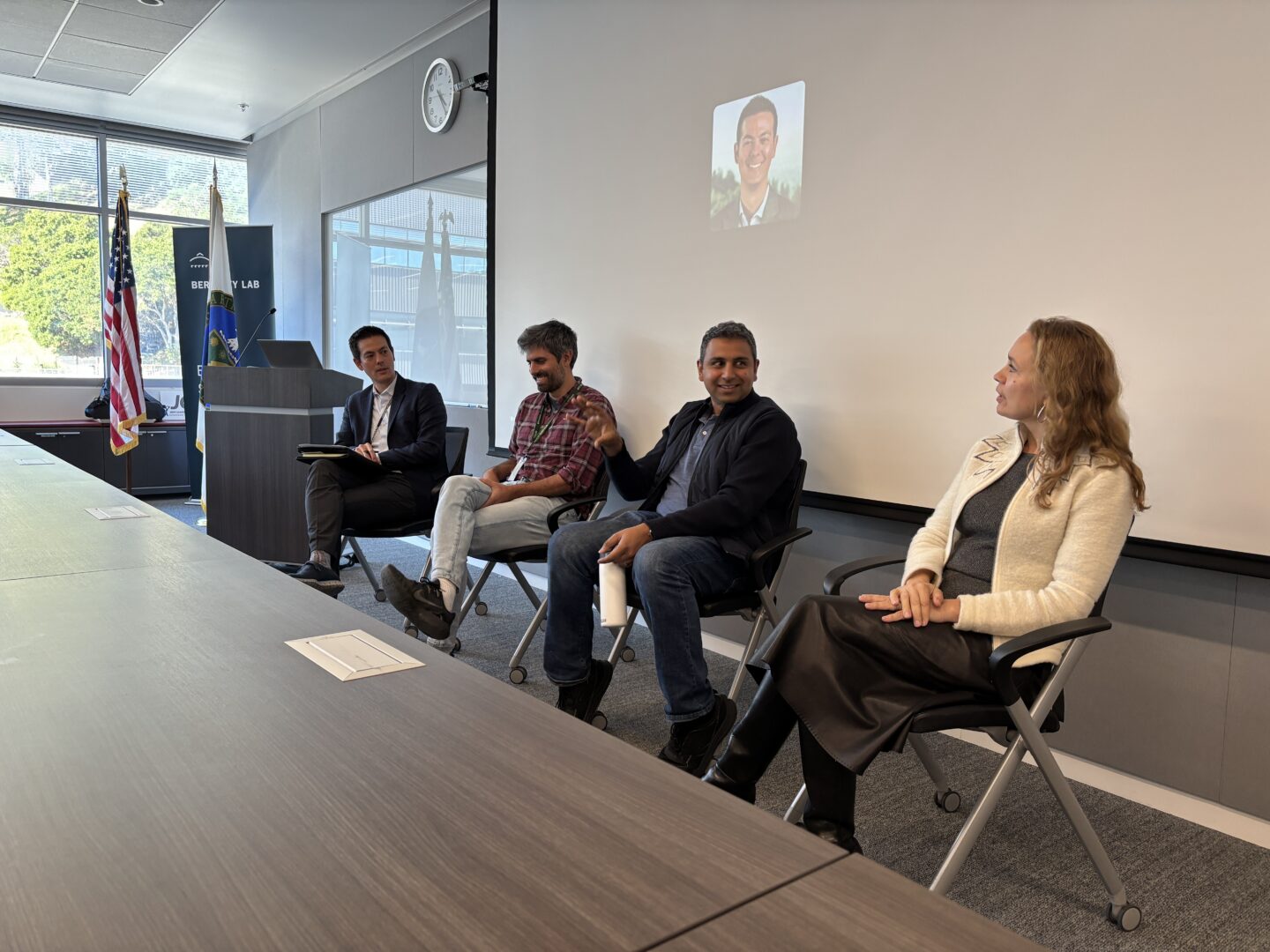
“We cut off email threads at a certain number,” said Anubhav Jain, associate director of the Materials Project, at the latest AI for Science collaboration event. When the screens are ditched for in-person interaction, “things just get resolved so much better.”
Joining Anubhav were Kristin Persson and Patrick Huck, respectively the director and technical lead of the Materials Project. All together, the three have years of experience managing multi-disciplinary teams and fostering the important relationships that make big projects run smoothly.
What grew from a small proposal for a Laboratory Directed Research and Development project is now an open-source website for materials discovery, with around 750,000 registered users, 200,000+ materials, and partnerships with industry giants like Meta,Toyota, and AWS. The whole endeavor is run by a team of around 20 people spanning theoretical physicists, materials scientists, chemists, platform architects, and machine learning experts. Multi-disciplinary teams like this are essential because AI-powered research requires a fusion of domain-specific expertise to ensure scientific accuracy and technical proficiency to build robust models and useful interfaces.
While some decisions like the design of digital buttons may seem minor, the way such small discussions are handled as a team can set the stage for much larger questions, such as choosing a software language or database architecture. Anubhav, Kristin, and Patrick share their lessons learned for fostering collaboration among diverse group members.
Prioritize team meetings
For 11 years, the team has been holding a weekly Tuesday 10 am meeting that they attribute to their successful communication. It gets prioritized; other meetings get bumped.
“I tell people, I have a 10 am meeting. You cannot get that slot,” Patrick emphasized.
And importantly – it’s in person.
“People have to learn from each other and they have very different expertise. You have to be in the same room…it takes really tight coordination,” Kristin added.
Learn a new language
Patrick is no stranger to working across domains. Trained in nuclear physics and then transitioning to software engineering and now platform architecture, he’s learned how to adapt to working with experts across specific scientific disciplines.
When joining the Materials Project team, “I had to do a lot of mental translating of, ‘What is the vision that they are trying to communicate? What are the scientific research requirements?’ And then over time, ‘How does that translate into resilient and cloud-native computing?’”
Now, when new members join the project from other disciplines, the team takes the time to learn about their background and try to speak their “language”. Patience and respect are core values in this mutual learning exchange.
Having built up the muscle for cross-discipline collaboration ensures the team stays connected as the make-up of the team evolves and even more languages join the conversation. Early on in the project, more generalists were needed, people who could build both the scientific capabilities and the underlying infrastructure. As the project has matured, it has transitioned to a more modular and scalable architecture, necessitating more domain specialists across computer science, materials science, and physics to independently advance and optimize individual components.
Build shared values
Critical to navigating the growing pains of diverse perspectives is building a set of shared values that can help establish bonds and improve collaboration.
One of those values: it’s okay to make mistakes.
“You try something and if that doesn’t work out, you change it,” Kristin added. “I don’t know how many generations of front-end architectures and different kinds of tools that we have changed over the years.” Experimentation is part of the team’s culture.
Just as important are building trust and support among coworkers. They find creative ways to provide credit, such as dual citations for both science and data sets, or including infrastructure engineers as co-authors on technical papers, so that everyone involved either building or using the AI platform is recognized.
In the sea of options big and small that the team at the Materials Project has to decide on every day, there is one thing they can agree on: human relationships matter.
