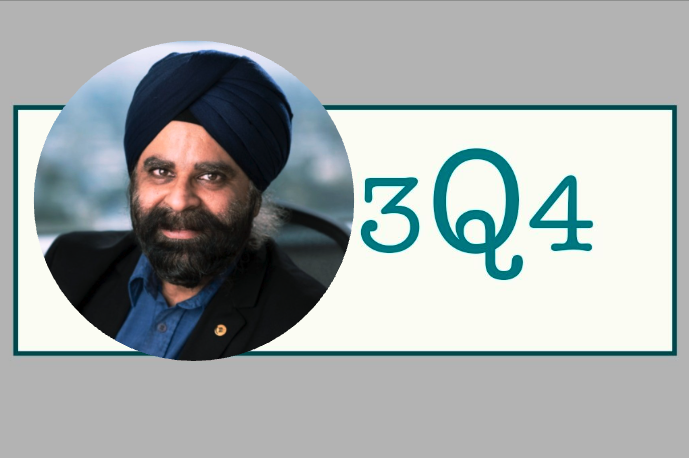
Inder Monga, who grew up in the small town of Ranchi in India, did not see his first computer until he was a freshman in college and first used a shared-access personal computer as a senior. Today, he’s deep into computing as the Director of the Scientific Networking Division and Executive Director of the Energy Sciences Network (ESnet). ESnet provides high-performance data transfer connections linking all 17 national laboratories and 28 user facilities, scientific instruments, universities, and other research institutions across the world. As Deputy Project Lead for the American Science Cloud (AmSC) under the Genesis Mission, Inder co-leads the team architecting a secure, federated, and science-optimized cloud environment that integrates the DOE’s computing and experimental facilities to facilitate AI-driven research.
Tell me about your career path.
My career path has taken many turns. I went to a competitive college in India, the Indian Institute of Technology in Kanpur, and then to Boston University for a master’s degree. In 1993, after school, in the middle of the dotcom boom, I joined Wellfleet Communications, a networking company (ranked by Fortune magazine as the fastest-growing company in the U.S. in 1992 and 1993). That was the start of my career in networking. I eventually grew into a management position there. With the dotcom crash in 2001, I went from delivering software products and managing teams at Wellfleet to doing research at Nortel, writing lots of papers and getting patents. In the next eight years I saw a lot of career growth, ultimately leading a $30 million research effort for Nortel’s optical networks unit, and reporting to the CTO. Then another downturn came in 2009, which I took as an opportunity to move to California to be closer to family.
I took on a one-year software engineering engagement at Berkeley Lab when ESnet5 was just getting launched with the support of ARPA-E stimulus funding. I was one of the first four hires for that effort. It was my first experience working with a national lab, and I enjoyed it so much that I asked to stay on after my assignment ended. I became CTO of ESnet in 2012, then in 2016 when ESnet’s then-director Greg Bell left, I became director. It’s been an amazing journey.
I really believe in the importance of networking. It has changed society. Apple, Facebook, Amazon, social media—none of these would have been possible without networking. It is the reason we can now all share in the advances of AI. I was thrilled to be named Deputy Project Lead of the American Science Cloud, building not just a single technology or platform, but building the fabric to integrate all the national labs and accelerate scientific discovery.
Can you share some career success tips with others at the Lab?
The biggest thing is to always be open to ideas and opportunities. Listen to what others have to say. Be open to learning new things. There’s no need to know everything; life is not about solving problems you already know. Raise your hand for new projects. Trust that you can work with others to tackle new problems.
It’s also important to focus on the essence of a problem or of what someone is trying to say. If you don’t understand what it’s really about, you can’t take appropriate action.
Don’t worry about your title; instead, consider whether the work is interesting and challenging. Likewise, don’t slow yourself down with what you think others think of you.
Last but not least, clear communication is important at the Lab. In addition to having the technical skills, if you’re able to communicate the essence of your ideas effectively, you can have a greater impact.
You are the executive sponsor of the Asian Pacific Islander Employee Resource Group (API ERG). Why is that important to you?
I believe that a sense of community and belonging are important to all of us. Employee resource groups welcome all to participate in the Lab and build a culture that encourages us to support one another. This culture helps us to solve tough problems together.
ERGs also encourage cross-divisional interactions that don’t always come up in our regular roles. Today, the intersection of disciplines and cultures is where innovation happens and new ideas develop.
I think ERGs play a very important role at the Lab, and I would like to see more recognition for all the employees who volunteer their time and dedication to ERG communities and activities. The whole Lab community benefits from their contributions.
***
For more information:
API ERG Career Development Panel, May 27
Inder Monga will be participating in the API ERG Career Development Panel on May 27 at noon at the Building 50 auditorium. Other panelists are: Chief Stewardship Officer Lady Idos, Senior Advisor for Strategy Branden Brough, ALS Staff Scientist Greg Su, and EESA Executive Administrator Melanie Yip. API ERG’s co-chair and Principal HR Division Partner Tina Clarke will serve as moderator. Add the event to your calendar.
ESnet Explainer Video (runtime 00:01:26)
Asian Pacific Islander Employee Resource Group (API ERG) web page (LDAP required)
