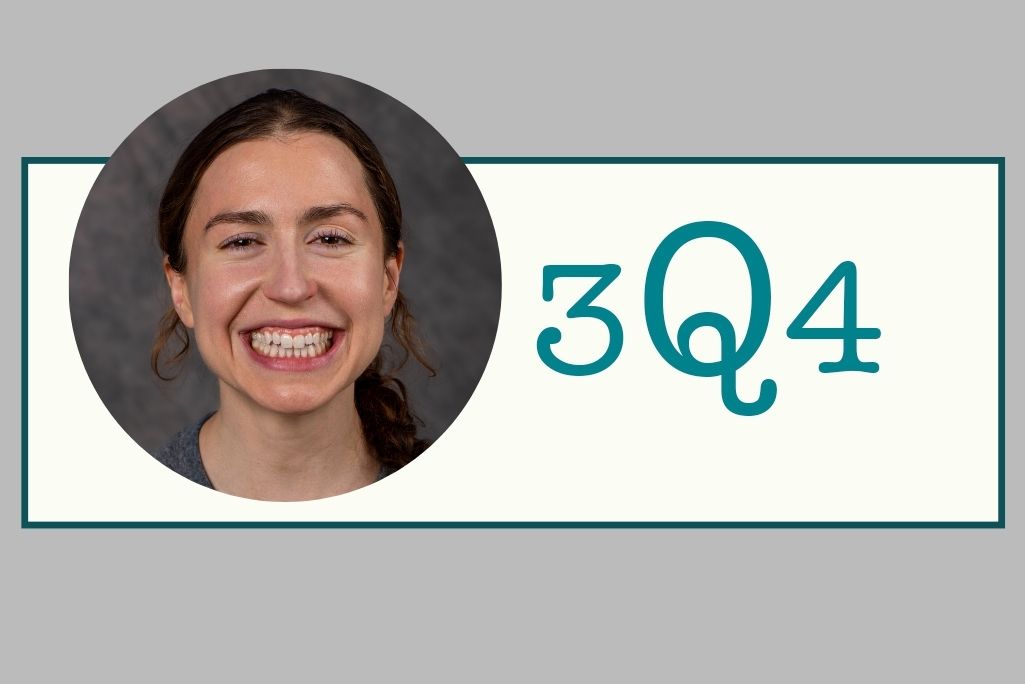
Katie Klymko is shaping the future of quantum computing as an Engineer in the Advanced Technologies Group and Quantum Computing Advisor at NERSC.
Her career at the Lab was sparked during her PhD in theoretical chemistry at UC Berkeley, where discussions with a postdoctoral mentor led to a quantum project with Bert de Jong and set her on the path to her career. After a postdoc in the Applied Mathematics & Computational Research Division in the Computing Sciences Area, she moved to a staff role at NERSC in 2021, where she now works to advance the future of scientific infrastructure.
Within the Advanced Technologies Group, Katie is helping to prepare for the next-generation of NERSC supercomputers, NERSC-11 (slated for 2032), and working to understand how quantum hardware should be a part of future systems.
Q. As NERSC’s newly named Quantum Computing Advisor, what excites you most about your new role?
In this role, I’m helping at a high level to make sure people understand what the quantum landscape looks like and plan how to prepare for it.
To give a bit of background, we still don’t have truly useful quantum computers, which isn’t a controversial thing to say since we’re still developing them. But there is a lot of wonderful work happening in hardware and algorithms, and we’ve reached this interesting stage where the government is really pushing the idea that these machines could become useful much sooner than we thought a few years ago.
What excites me is that we’re looking at serious efforts to incorporate quantum computing into NERSC. The interest from our users grows every year, and we’re working directly with quantum vendors to test state-of-the-art hardware and find out what we can actually do with it in the near future.
And the field is just moving incredibly fast. Even though we don’t yet have machines that can do things (that people care about) classical computers can’t, the pace of the advances is remarkable. I love being in it right now — it’s fast-moving, and so many smart people are working in this area. It’s also a little terrifying, because just keeping up with the speed of development is a big job.
Q. You’re known as a proactive mentor to postdocs and interns. What does that work mean to you?
Mentoring so many interns has been an incredibly rewarding experience, and I am consistently impressed by how talented our students are. I find myself constantly learning from them, and many choose to stay on with us for longer periods than just the summer. For graduate students in particular, our objective is to help them achieve a tangible outcome, such as publishing a paper. Since this process can easily take up to a year, we often build relationships that extend beyond their initial internship. While mentoring is certainly one of my most time-intensive responsibilities, it is undoubtedly one of the most fulfilling.
It’s also deeply gratifying to watch these students progress in their careers. For instance, I introduced my intern from last summer to a contact at QuEra, one of our partner quantum computing companies, which helped him secure an internship there for this summer. While his success is his own, I feel proud to have made that connection and to see him advance in the field. Similarly, our postdocs are exceptional. Collaborating with them is a real privilege.
I try to make it a point to emphasize to both our students and postdocs just how important they are to the Lab. Often, they join us feeling really grateful for the opportunity, but I want them to know that the gratitude is mutual. They are arguably the most valuable people we have at the Lab and UC Berkeley because they are the ones driving the actual work. It can be easy to dismiss them as “just students,” but they’re our greatest strength, and I want them to recognize that.
Q. What do you appreciate most about working at NERSC?
From my perspective, NERSC is truly one of the best parts of the Lab, and I love working here. It’s not just about the great work being done in quantum computing or AI, which are areas receiving a lot of attention right now, but the wonderful collection of people dedicated to serving the broader scientific community. It’s just a great place to do this type of work. Having spent time in different areas at the Lab, I feel that NERSC perfectly exemplifies our shared value of team science.
