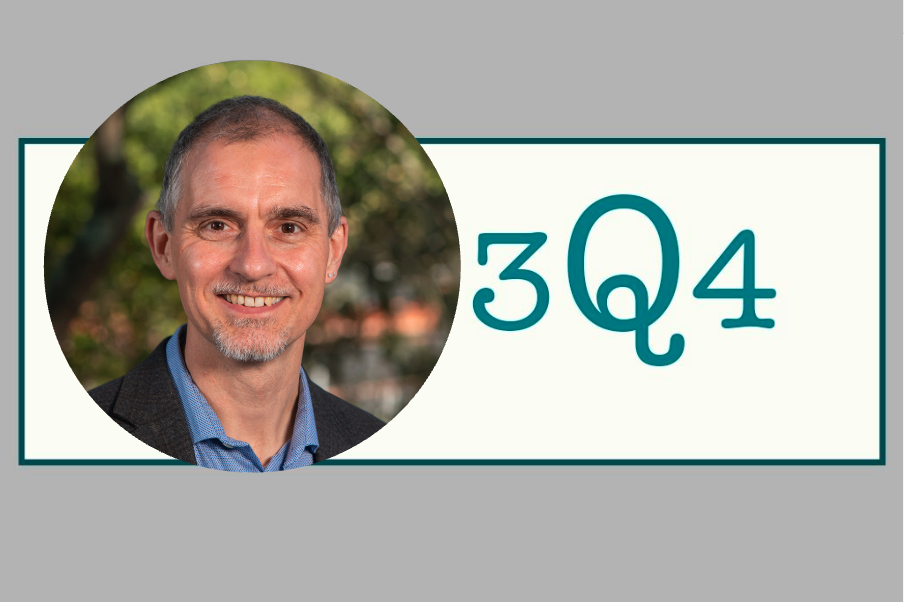
Reiner Kruecken is the Associate Laboratory Director for the Physical Sciences Area (PSA), which is home to four divisions — Accelerator Technology and Applied Physics, Engineering, Nuclear Science, and Physics. PSA has a broad remit — researchers and engineers in the Area seek to understand the fundamental physics of the universe at scales ranging from the infinitesimally small, inside the world of subatomic particles and nuclei, to the infinitely large, including the structure and evolution of the universe. PSA also develops and produces engineered devices such as detectors and magnets for some of the world’s most advanced accelerator facilities, telescopes, and particle detectors.
Reiner started in the ALD position on July 1. Before becoming ALD, he was Division Director of PSA’s Nuclear Science Division from 2022. Prior to that, he served as Deputy Director and Chief Research Officer at TRIUMF, Canada’s particle accelerator center. An internationally recognized nuclear physicist, Reiner has also held faculty positions at the University of British Columbia, the Technical University of Munich, and Yale University, and played leadership roles in major international collaborations and advisory bodies in Europe, North America, and Asia. Reiner received his doctorate in nuclear physics from the University of Cologne, Germany, in 1995, working on gamma-ray spectroscopy.
In his spare time, Reiner enjoys hiking, biking, and spending time in nature. Although he doesn’t profess to be a great chef, he is handy in the kitchen and likes to cook many types of cuisines, from Mediterranean to Asian.
In this interview, he shares his thoughts about the Physical Sciences Area’s strengths and strategy for the future, the importance of the Lab’s stewardship values, and tips for success at the Lab.
What are PSA’s particular strengths?
I think our people are our main strength. We have really talented people who are leaders in their respective fields and form high-performing teams. We are lucky that we continue to be successful in attracting the best and brightest. Our history in physics leadership, our strong connection with UC Berkeley, and the wonderful location that is the Bay Area — I think all of that brings the best people here.
The Lab also has world-leading technological capabilities for the physical sciences — accelerators, detectors, and associated facilities and technologies, like our deep expertise in gamma-ray and particle tracking detectors and in control systems for lasers, accelerators, and quantum information systems. The combination of people and technological capabilities makes the Lab a unique environment and allows us to play a leading role in identifying the most interesting and most important scientific questions about the origin and fate of our universe, and to drive cutting-edge research to address them.
We continue to be a world leader in many areas — particle physics, cosmology, nuclear science, and accelerator science and technology — and in both discovery and applications. We contribute to accelerators and large-scale experiments across the whole DOE complex and beyond. We are known for our radiation detection and imaging technology innovations, as well as for their applications in security, space, and nuclear medicine. Our outstanding Engineering Division drives innovation through its matrixed staff, enabling the delivery of major projects like GRETA, DESI, and ALS-U. This combination of talent and capabilities with the Lab’s team science approach is what allows us to lead in many areas of physical sciences.
What are some of your near-term priorities as ALD?
I want to continue to support our teams in advancing first-class science with our ongoing programs and in delivering on our commitments for ongoing projects and facility operations. It’s also important to consistently communicate our value proposition to our sponsors. The DOE is aligning its high-energy and nuclear physics efforts, and recently announced that it will merge these two program offices into one – the DOE High Energy and Nuclear Physics program office. We have much to offer the combined program, from neutrino and collider physics to accelerator and detector R&D.
Building on our strong core value of Team Science, I want to continue to foster an Area culture that is welcoming and engaging, and strengthen cross-division and cross-Area collaboration. This will advance innovation and help us to take advantage of opportunities with the new DOE Office of High Energy and Nuclear Physics. PSA is already highly collaborative, working with divisions in all Areas at the Lab. Among others, we work closely with Computing Sciences on high-performance computing, AI, quantum computing, and quantum information science. The Genesis Mission is obviously a big focus at the moment. Our Engineering Division is matrixed into the ALS and ALS-U and other divisions across the Lab. ATAP and Engineering advance R&D in several joint centers. PSA also has a strong partnership with the operations side of the Lab.
At the same time, I think there are even more opportunities that we haven’t tapped into yet, and I’m looking forward to having conversations to identify those so that we build even more connections. For example, we have recently started discussions with the Biosciences and Energy Sciences Areas about opportunities to collaborate on medical applications for imaging and treatments using PSA’s expertise in detector and accelerator technologies. These technologies also have applications in energy sciences like chemistry or materials sciences, nuclear security, and resource exploration. I see further opportunities in robotics, sensor networks, data streaming, and others.
These efforts will enable us to further diversify PSA’s funding portfolio. We are primarily funded by the DOE Office of Science High Energy and Nuclear Physics program and need to navigate current budget challenges and ensure we are agile for the future. And while some programs already have significant funding from other sponsors, like nuclear security agencies, we need to broaden that to include other federal and non-federal funding sources, and private sector partners. This effort will build around strengths that we have in accelerators, detectors, imaging, quantum information, and of course AI.
Stewardship culture more broadly is an overarching priority for me. It’s important that our decisions are anchored in strong values. I’ve helped foster this in the Nuclear Science Division. For example, with the division’s Community Stewardship Committee, we developed a Community Agreement that set guidelines for work-life balance and for our responsibilities to ourselves, our colleagues, the Lab, and the broader scientific community. The committee also conducted regular pulse check surveys to identify and address emerging issues on stewardship and career development. At the Area level, I will continue to help build a cohesive Area stewardship culture and instill the importance of our values and the “One Lab” spirit. It is important that we keep reminding each other of our values, and hold ourselves and each other accountable. As ALD, I will do my best to lead by example and live our values, and ask that people call me out whenever I fall short.
What do you most appreciate about the Lab and how do you think people can be successful here?
As a postdoc many years ago, I was mostly focused on my own research, not aware of all the research going on in the division, area, or the Lab. Having been away from the Lab and in various other roles and organizations, I am now much better able to appreciate the broader multi-purpose nature of the Lab’s scientific program.
At Berkeley Lab, the breadth of forefront science, across all the disciplines, is just amazing. And still, there are opportunities to further strengthen that, and to learn from each other and help each other thrive. Looking for ways to collaborate, being curious about what else is going on, and finding ways to connect ideas and people, has certainly helped me to develop as a scientist and leader. To make the most of the Lab’s environment and to thrive in it, it’s important to appreciate and respect the people, their talents and expertise, both on the science and operations side. In short, being curious and to live the Lab’s stewardship values and to embrace the “One Lab” team science spirit is, I believe, the recipe for success.
