
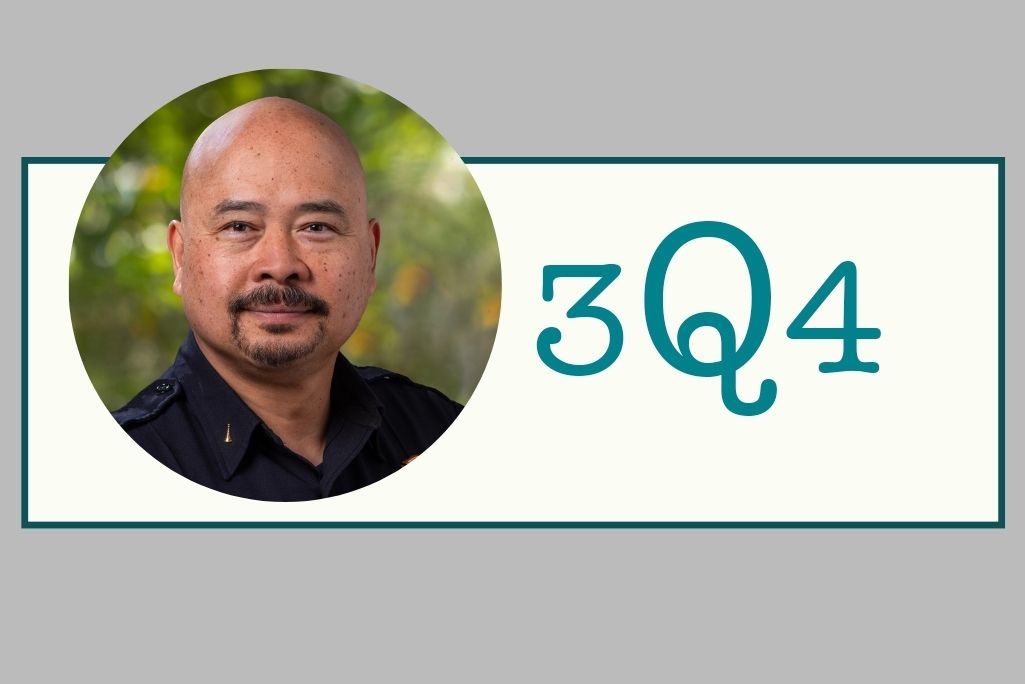
Q. How did you come to lead this training program?
Prior to joining Berkeley Lab, I spent close to 24 years as a firefighter paramedic for the City of Alameda, retiring in 2022. But I soon realized I needed to stay active for sanity’s sake. I was fortunate to secure a position in the Lab’s Fire Marshal’s Office, which allowed me to familiarize myself with the organization and, in particular, its deep commitment to a strong safety culture.
In my initial role at the Lab, I was required to complete a mandatory CPR/AED training course. The instructor was an excellent presenter, but I felt the training could go further by drawing on real-world, hands-on experience. Even after completing the required course, I observed that many participants still did not feel confident and would likely panic if faced with an actual emergency — an entirely natural reaction.
Recognizing this, I believed the Lab could significantly benefit from an alternate approach to training. By drawing on my firsthand professional experience, I could demonstrate how straightforward these skills really are and emphasize their proven track record for saving lives. After learning that only a portion of the Lab workforce receives this instruction, I asked colleagues across the Lab to gauge their interest, and 100% of them responded affirmatively. This prompted me to contact Dr. Joseph Toscano, the Lab’s Site Medical Director, to propose expanding the program, which got the ball rolling.
I knew that leveraging my background and skill set would allow me to bring this enhanced approach to Berkeley Lab, ensuring we continue to strengthen our safety culture.
Q. What’s the most common misconception about performing CPR or using an AED?
The most common misconception about CPR and AED use, and we get this a lot, is: “Am I going to crack the person’s ribs?” People think that if they do chest compressions, they’re going to crack a rib and hurt the person more. During our class, we explain the anatomy of the sternum and the chest, and while there’s a possibility of cracking ribs, more than likely what they’re hearing is a dislocation of the ribs from the sternum.
Humans are, by nature, mostly about compassion. We don’t want to harm people. But in reality, when someone is undergoing cardiac arrest, you can’t hurt them more because — as gruesome as this sounds — they’re pretty much already deceased. So when you’re administering CPR, we emphasize that you have to press hard and fast, since you’re essentially taking over the heart’s function as an external pump.
That’s why we use scenario-based training. We want students to feel the pressure in the classroom so that when they feel it in real life, they’re prepared. We don’t sugarcoat things. We share the facts, what we’ve seen in our experience, and what actually works. By doing that, we’re able to build our participants’ confidence in approaching real-world situations.
This is definitely a confidence-building class, not an intimidating “you have to do it exactly this way” kind of course. It’s about letting people feel comfortable performing the skill. We talk through all the possibilities of what can happen when someone is going through this, including real-life complications like vomiting or bleeding, so nothing catches them off guard. This prepares students to continue performing CPR safely, using proper precautions and personal protective equipment.
Q. What are your goals for bringing this training to the entire Lab population?
My goal is to make sure that the majority, if not every single person, at the Lab is equipped with this skill set. While the hope is that they will never actually have to use it, having it tucked away in their mind provides a valuable tool to potentially save someone’s life. I joke, but I am serious: I am not young anymore, and if an emergency happens, I want the person next to me to be confident in performing quality CPR on me.
I’m passionate about this training because I have seen it work firsthand. It is incredibly easy to perform, yet so many people have never been properly taught how to do it. Ultimately, it’s about making sure everyone has a tool to help in an emergency. That’s my goal: to significantly increase our community’s safety.
How to Sign Up
The training is currently offered quarterly, with additional sessions based on demand. Sign up for the next session via Google Forms here to reserve your spot.
